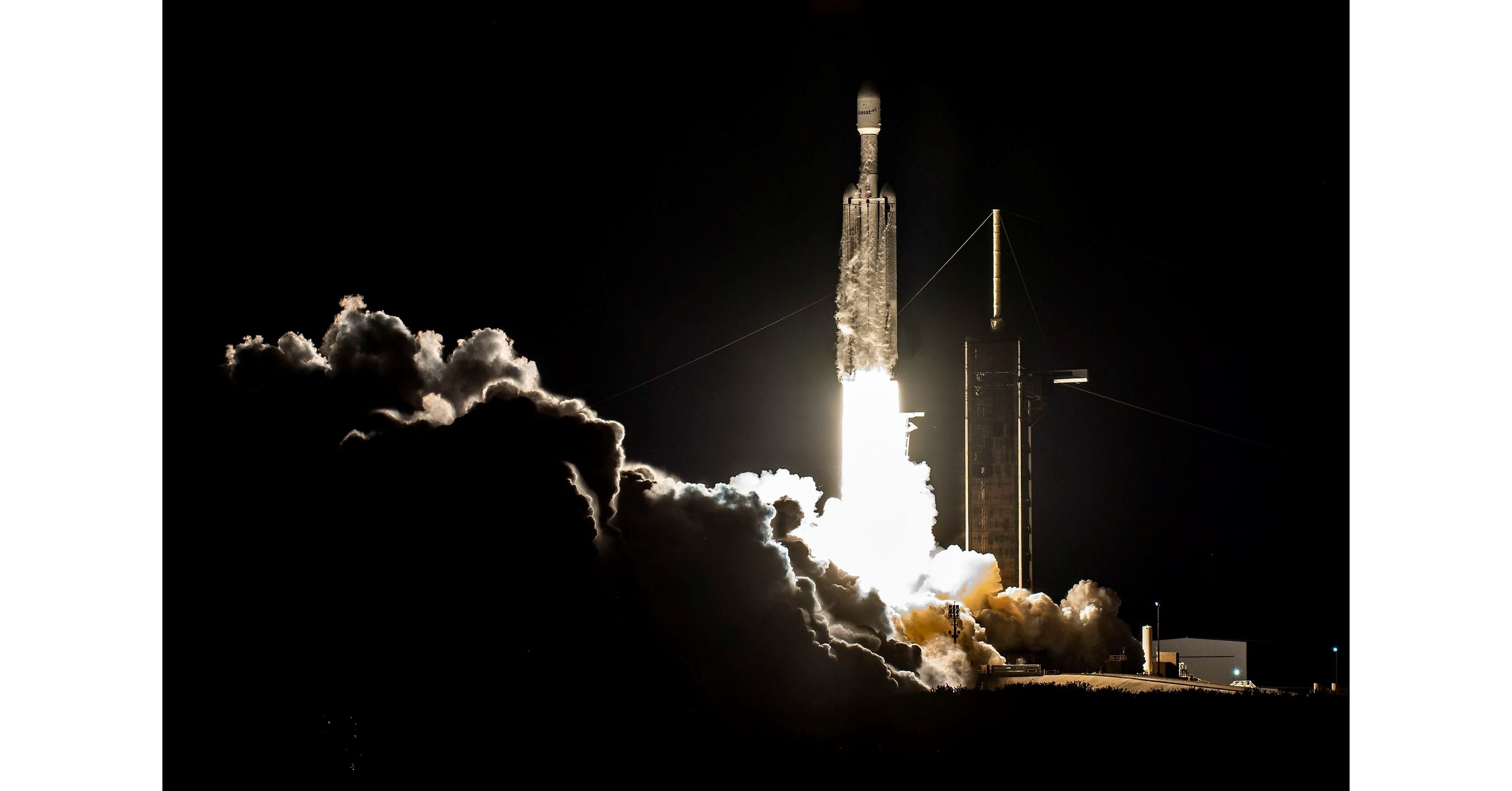
SpaceX Launches Falcon Heavy with ViaSat Satellite from Kennedy Space Center
SpaceX successfully launched its Falcon Heavy rocket on April 29, 2026, marking the first such mission in 18 months. The rocket carried a ViaSat-3 internet satellite into orbit from Florida's Kennedy Space Center. The side boosters landed successfully, while the central booster was discarded in the Atlantic Ocean.
prnewswire.comSpaceX launched its Falcon Heavy rocket on April 29, 2026, carrying a ViaSat internet data relay satellite from Kennedy Space Center in Florida. Powered by 27 Merlin engines in three strapped-together Falcon 9 first stage boosters, the rocket boosted the ViaSat-3 satellite into its planned preliminary orbit.
Post by @SawyerMerritt on X
The two side boosters separated two minutes and 25 seconds after liftoff and executed on-target touchdowns on separate pads at the Cape Canaveral Space Force Station. The central booster separated a minute-and-a-half later and was jettisoned into the Atlantic Ocean.
The upper stage required three engine firings to place the ViaSat-3 satellite in an elliptical orbit. The launch was originally set for Monday but was scrubbed due to poor weather. The previous Falcon Heavy mission occurred in October 2024 and carried NASA’s Europa Clipper spacecraft to Jupiter.
The Falcon Heavy set the ViaSat satellite on a trajectory toward a geosynchronous transfer orbit. The first Falcon Heavy launch occurred in 2018.
ViaSat is stationing larger, more powerful satellites in geosynchronous orbit to provide global space-based internet access on hemispheric scales.
The Falcon Heavy configuration has nailed all previous launches, producing more thrust than any other vehicle currently in commercial operation at liftoff, followed by pinpoint, near-simultaneous landings of the dual side boosters.
The maiden launch in 2018 sent a charismatic Starman dummy in Elon Musk’s cherry red Tesla on an infinite mission to orbit the sun somewhere between Earth and Mars. Footage of Musk rushing from the launch control room to go outside and watch Falcon Heavy’s first-ever ascent through the atmosphere has become the stuff of space legend and meme lore.
Meanwhile, Starship has continued its elongated campaign of explosive test flights that have delayed his initial ambitions of reaching the moon and Mars by the end of the decade. SpaceX is actively building a constellation of Starlink satellites in low-Earth orbit that provide internet access by routing data from users to satellites passing overhead, which in turn relay the signals to and from ground stations.
So far, the company has launched nearly 12,000 Starlinks in nearly 400 launches over the past seven years. Blue Origin also is building a planned constellation of some 3,200 broadband satellites in low-Earth orbit, with 270 launched to date. Amazon's LEO satellites eventually will compete head to head with SpaceX's Starlinks.
The company intends for Starship to handle heavy lift missions in the future, and it’s designing many payloads for the next-generation vehicle, leaving Heavy less in demand. For rocket enthusiasts, it remains a reminder of a critical milestone in aerospace engineering and likely a precursor of more impressive accomplishments to come.
Key Facts
Story Timeline
6 events- 2026-04-29
SpaceX’s Falcon Heavy rocket launched carrying a ViaSat internet data relay satellite from Kennedy Space Center in Florida.
6 sources@SawyerMerritt · Forbes · CBS News - 2026-04-27
The launch was originally set for Monday but was scrubbed due to poor weather.
1 sourceForbes - 2024-10
The previous Falcon Heavy mission occurred and carried NASA’s Europa Clipper spacecraft.
2 sourcesForbes · CBS News - 2023-11
A second ViaSat-3 satellite was launched atop a United Launch Alliance Atlas 5 rocket.
1 sourceCBS News - 2023-05
The first ViaSat-3 satellite was launched.
1 sourceCBS News - 2018
The first Falcon Heavy launch occurred.
2 sourcesForbes · CBS News
Potential Impact
- 01
Completion of ViaSat's globe-spanning broadband constellation, enhancing internet access in Asia-Pacific.
- 02
Potential shift of first ViaSat-3 to cover Europe and Africa, expanding limited service areas.
- 03
Advancement in geosynchronous satellite technology competing with low-Earth orbit constellations like Starlink.
- 04
Demonstration of Falcon Heavy reliability, potentially influencing investor confidence ahead of SpaceX IPO.
- 05
Reminder of Falcon Heavy's role as bridge to Starship, possibly accelerating heavy-lift mission transitions.
Transparency Panel
Related Stories
VarietyMajor Publishers and Author File Copyright Lawsuit Against Meta Over AI Training Data
Five major publishers and author Scott Turow filed a class-action lawsuit against Meta and CEO Mark Zuckerberg in Manhattan federal court, alleging illegal use of copyrighted books and articles to train the Llama AI model. The suit claims Zuckerberg personally authorized the infr…
naturalnews.comBrockman Testifies on Heated 2017 Dispute with Musk Over OpenAI's For-Profit Shift in Federal Trial
OpenAI President Greg Brockman detailed a heated 2017 confrontation with Elon Musk during testimony in the federal trial Musk v. Altman. He described Musk storming around a table and grabbing a painting after rejecting shared control proposals. The lawsuit seeks $150 billion in d…
Trump Administration Explores Government Review of AI Models Before Public Release
The Trump administration is discussing measures to vet advanced AI models for safety and security risks prior to their release, marking a potential shift from its previous hands-off stance on AI regulation. Officials are considering an executive order to establish a working group…