Study Documents Internal Conflict and Lethal Attacks in Uganda's Ngogo Chimpanzee Community
Researchers observed a large chimpanzee group in Uganda's Kibale National Park split into two factions starting in 2015, leading to coordinated attacks by one subgroup on the other. The western subgroup conducted 24 attacks from 2018 to 2022, resulting in at least seven adult male deaths and 17 infant deaths.
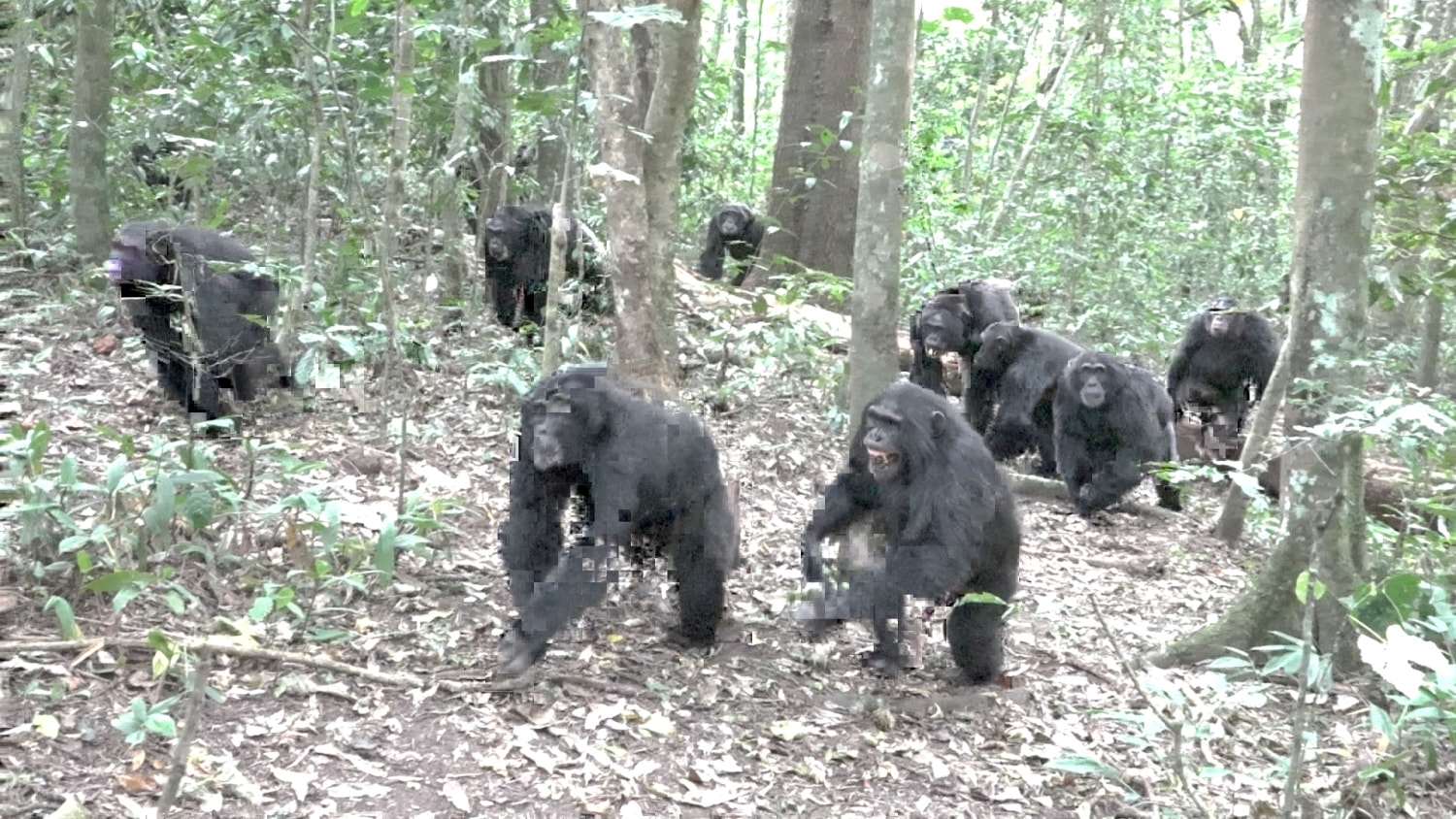
Nbc NewsA study published this week in the journal Science details the first observed case of internal conflict resembling civil war among wild chimpanzees in Uganda's Kibale National Park. The research focuses on the Ngogo chimpanzee community, the largest known wild group, which split into two distinct subgroups around 2015 after decades of cohesion.
This division led to sustained aggression, with one subgroup targeting the other in coordinated lethal attacks.
The Ngogo chimpanzees had maintained social unity from at least 1995 until 2015, based on over three decades of behavioral observations. In June 2015, primatologist Aaron Sandel noted unusual nervous behavior among a cluster of chimpanzees as other group members approached, marking the initial sign of fracture.
By 2018, the community had polarized into the western subgroup and the central subgroup.
2018 through 2022, members of the western subgroup launched 24 coordinated attacks on the central subgroup.
These assaults resulted in the deaths of at least seven adult males and 17 infants in the central group. The attacks involved organized efforts, including sustained pursuits and lethal violence. The central subgroup experienced the lowest survivorship rates ever documented in a wild chimpanzee community following these attacks.
Researchers attribute the aggression to efforts by the western subgroup to reduce competitors' reproductive success, aligning with principles of Darwinian fitness. No similar level of in-group violence had been fully documented prior to this case.
to the Split Changes in social hierarchy preceded the division.
On the morning of the June 2015 observation, the group's alpha male submitted to another chimpanzee, signaling a shift in leadership. The deaths of several key older individuals in the years before 2015 weakened social connections across the community's neighborhoods. A disease outbreak in 2017 further accelerated the split, according to researchers.

These events made the group vulnerable to polarization when the alpha change occurred. The study draws on genetic evidence suggesting such internal conflicts occur approximately every 500 years among chimpanzees.
“Cases where neighbours are killing neighbours is more troubling and, in a way, it gets closer to the human condition.”
suspect a similar rupture may have occurred in the 1970s within Jane Goodall's observed chimpanzee group in Gombe, Tanzania, but limited understanding of chimpanzee behavior at the time prevented full recognition of the in-group violence. The Ngogo case provides the first thoroughly reported instance of such civil warfare in the species.
It highlights how social ties, reliant on key individuals, can fragment under specific circumstances. Chimpanzees remain threatened with extinction, and human activities could increase the frequency of such conflicts. Factors like deforestation, climate change, and disease outbreaks disrupt social cohesion, potentially making inter-group violence more common.
The study underscores parallels to human group dynamics, where cooperation can rapidly shift to aggression.
Key Facts
Story Timeline
5 events- 2024 — Study published
Researchers publish findings in Science journal documenting the chimpanzee civil war.
2 sourcesThe Guardian · The New York Times - 2018-2022
Western subgroup launches 24 coordinated attacks on central subgroup, killing seven adult males and 17 infants.
2 sourcesThe Guardian · The New York Times - 2017
Disease outbreak accelerates the split between chimpanzee subgroups.
1 sourceThe Guardian - June 2015
Aaron Sandel observes nervous behavior signaling the start of group fracture after alpha male submission.
1 sourceThe Guardian - Pre-2015
Deaths of key older individuals weaken social connections in the Ngogo chimpanzee community.
1 sourceThe Guardian
Potential Impact
- 01
Central Ngogo subgroup faces lowest documented survivorship rates.
- 02
Human activities like deforestation increase chimpanzee inter-group conflicts.
- 03
Climate crisis disrupts chimpanzee social cohesion leading to more violence.
- 04
Disease outbreaks expedite social splits in chimpanzee communities.
- 05
Study informs conservation efforts to protect chimpanzee group stability.
Transparency Panel
Related Stories
NASA Releases Thousands of Photos from Artemis II Lunar Mission
NASA has released over 12,000 images from the Artemis II mission, which orbited the moon in April 2026. The photos capture views of Earth, the lunar surface, and a solar eclipse observed during the crew's return. Astronauts from the mission also visited the United Nations headqua…
newscientist.comHoutman Abrolhos Corals Show High Resilience to 2025 Heatwave, Unlike Global Losses
Coral reefs at the Houtman Abrolhos Islands off Western Australia endured a prolonged heatwave in early 2025 virtually unscathed, unlike widespread global die-offs. Researchers found exceptional heat tolerance across multiple species, with lab tests showing survival rates far exc…
deccanchronicle.comHantavirus Cases Reported on MV Hondius Cruise Ship, Three Fatalities Amid Low Transmission Risk
A hantavirus outbreak on the MV Hondius cruise ship has killed three passengers and sickened seven others, prompting an international response coordinated by the World Health Organization. The ship, carrying 147 people from 23 nationalities, is set to sail to Spain's Canary Islan…