Study Finds Small but Rising Share of Research Papers Contain Fabricated Citations
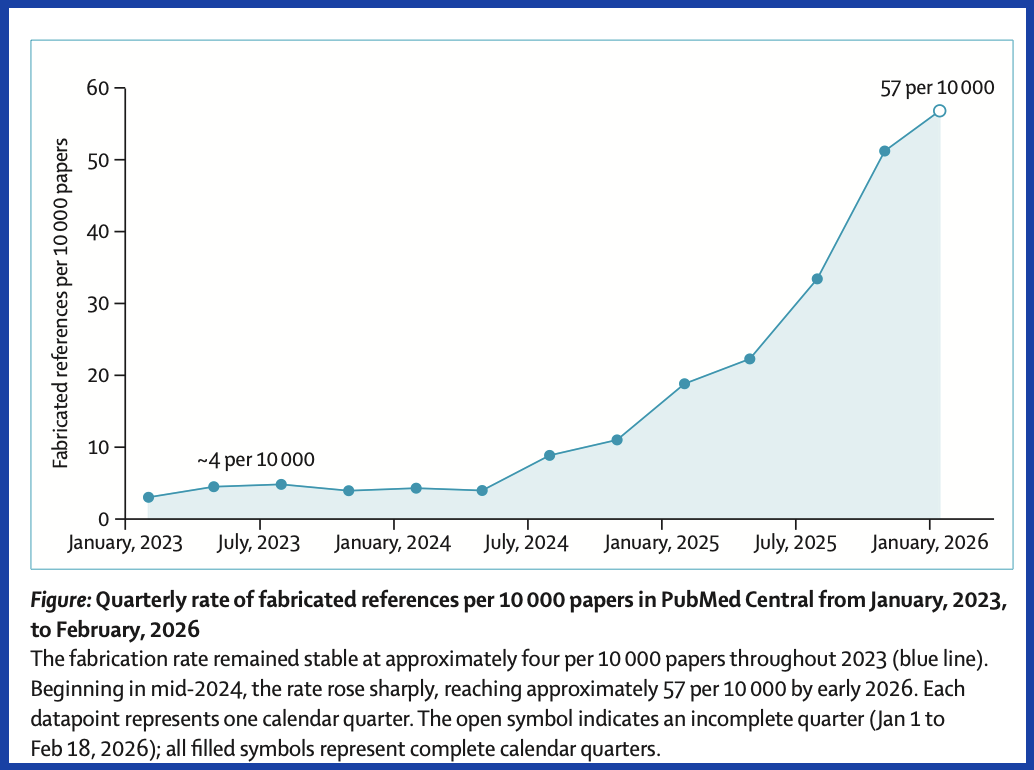
A Lancet study published May 7, 2026, found the rate of papers containing fabricated references rose sharply, reaching 1 in 277 during the first seven weeks of 2026. Columbia University researchers led by Maxim Topaz identified around 4,000 fabricated citations among 2,800 papers after reviewing more than 2 million papers and 97 million citations.
retractionwatch.comA new study on fabricated citations was published in the Lancet on May 7, 2026. The study, led by Maxim Topaz, a nurse and health AI researcher at Columbia University, identified around 4,000 fabricated citations among 2,800 papers after sifting through over 2 million papers and 97 million citations. In 2023, 1 in 2,828 papers contained one or more fabricated references.
By 2025 that rate had climbed to 1 in 458 papers, a sixfold increase in frequency. During the first seven weeks of 2026, the rate of papers with fabricated references reached 1 in 277. More than a third of fabricated citations come from two publishers.
The analysis itself was prompted by an experience involving generative AI. Maxim Topaz used an AI chatbot to help edit an editorial and an erroneous citation was flagged by a journal editor despite his checks.
"I was deeply embarrassed: I checked for that, and it still almost happened to me. This is how I ended up thinking about other people," Topaz said. The Columbia University researchers who authored the paper concluded that tools using generative AI are likely to blame for the spread of fabricated citations that do not reference real academic papers.
These citations are polluting the public record of science. Misha Teplitskiy, a sociologist of science at the University of Michigan who has studied citation practices and AI use among academics, reviewed the findings. " Mohammad Hosseini, a professor at Northwestern University who studies research integrity and the ethics of AI use, offered a separate assessment.
The proliferation of fabricated citations could affect systematic reviews or clinical guidelines that build on existing studies. It also points to broader changes in citation practices, shifting from reflective engagement with literature to a more superficial process aided by AI prompting.
The Science family of journals uses an automated tool to check references and has not had a published paper with a fabricated citation.
@statnews reported that spokespeople for other prominent biomedical journals, including the New England Journal of Medicine and JAMA, said their outlets employ citation validation tools and hold authors responsible for accuracy. The study authors are Columbia University researchers.
Fabricated citations are not distributed evenly across journals, according to a dashboard published alongside the paper.
Key Facts
Story Timeline
4 events- 2026-05-07
Lancet publishes study on fabricated citations led by Maxim Topaz
1 source@statnews - 2026-01-01 to 2026-02-19
Rate of papers with fabricated references reaches 1 in 277 during first seven weeks of 2026
1 source@statnews - 2025-12-31
Frequency of papers containing fabricated references hits 1 in 458
1 source@statnews - 2023-12-31
Baseline rate stands at 1 in 2,828 papers with fabricated references
1 source@statnews
Potential Impact
- 01
Erosion of reflective citation practices in favor of AI-generated lists
- 02
Signals declining research integrity linked to publication pressure
- 03
Potential compromise of systematic reviews and clinical guidelines relying on cited literature
- 04
Increased workload for journals implementing automated reference validation tools
Transparency Panel
Related Stories
Substrate placeholder — needs reviewAkamai Signs $1.8 Billion Seven-Year Cloud Deal With Anthropic
Akamai Technologies announced a $1.8 billion seven-year contract with Anthropic for its Cloud Infrastructure Services, the largest in the company's history. The deal was disclosed in Akamai's first-quarter 2026 earnings report. Akamai shares rose 27 percent on May 8 following the…
techjuice.pkTrump Administration Considers New Oversight for Advanced AI Models
Anthropic's unreleased Mythos model, capable of autonomously finding software vulnerabilities, prompted a White House shift from its previous hands-off AI policy. President Trump is considering an executive order to establish a formal review process for the most powerful systems,…
pandaily.comNvidia CEO Jensen Huang Says He Does Not Mind Paying $8 Billion in California Taxes
Nvidia CEO Jensen Huang stated he is comfortable with his tax payments to California while speaking at the Milken Institute Global Conference. Huang addressed the proposed billionaire tax and affirmed his decision to continue living in the state. The comments came as conference a…