Supreme Court Rules 6-3 That Louisiana's Redistricting Violates Voting Rights Act in Racial Gerrymander Case
The U.S. Supreme Court issued a 6-3 decision in Louisiana v. Callais, adjusting interpretations of Section 2 of the Voting Rights Act to focus on intentional discrimination. The ruling invalidated a Louisiana map creating a majority-Black district. Former President Barack Obama criticized the decision, while supporters hailed it as promoting legal consistency.
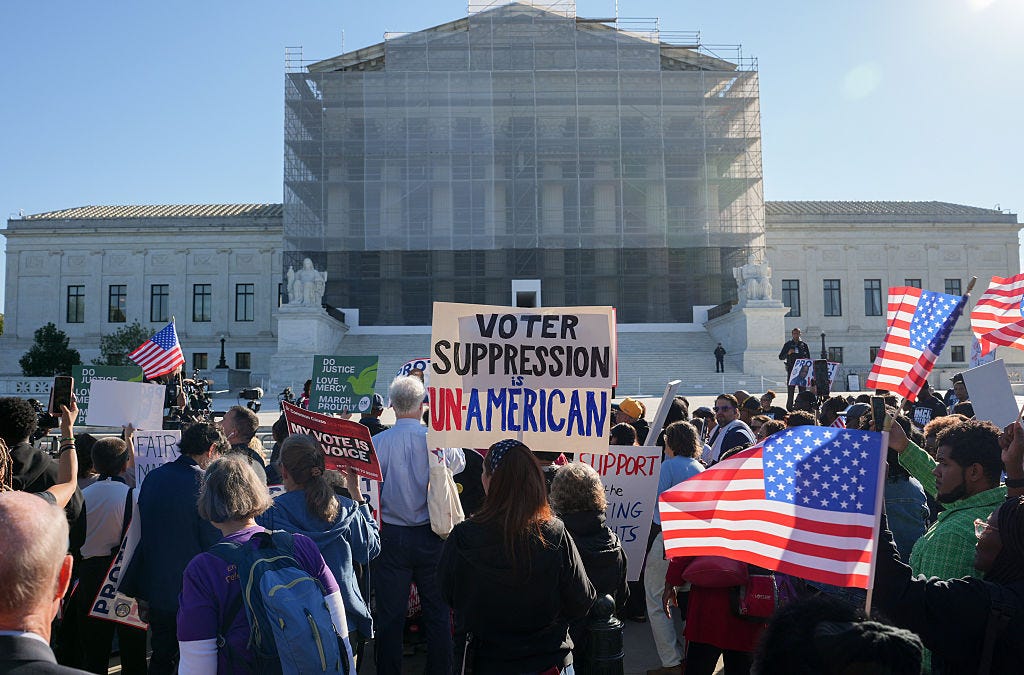
Dietmar Rabich / Wikimedia (CC BY-SA 4.0)U.S. Supreme Court issued a 6-3 decision in Louisiana v. Callais on April 29, 2026, ruling against Louisiana's 2024 mid-decade redistricting that produced a serpentine district represented by Rep.
Cleo Fields of Baton Rouge. The court declared the map an illegal racial gerrymander. The decision, handed down on a Wednesday morning, was led by Justice Samuel Alito. It holds that Section 2 of the Voting Rights Act cannot constitutionally enforce the Fifteenth Amendment by prohibiting maps based solely on disparate impacts.
Section 2 of the Voting Rights Act prohibits practices or procedures that deny or abridge the right to vote on the basis of race. For more than a generation, the Supreme Court interpreted Section 2 to require drawing electoral districts to allocate representation to racial blocs in certain situations.
The Constitution forbids drawing electoral districts where race predominated in voter assignment unless it meets strict scrutiny as serving a compelling interest in the least discriminatory way.
The Supreme Court had previously avoided deciding whether complying with Voting Rights Act requirements could satisfy strict scrutiny as a compelling interest. The Callais decision adjusts tests from the 1986 case Thornburg v. Gingles to reflect the actual words of Section 2 and refocus on intentional racial discrimination prohibited by the Fifteenth Amendment.
Under Callais, Section 2 imposes liability only when circumstances give rise to a strong inference that intentional discrimination occurred. The Gingles test from 1986 required plaintiffs to show: (1) the racial minority was sufficiently numerous in a compact area to constitute a majority in an additional reasonably configured district; (2) the minority was politically cohesive; (3) a racial majority bloc-voted sufficiently to defeat preferred candidates; and (4) the totality of circumstances reflected a local political process unequally open to minority voters.
The Callais decision revises the first prong of the Gingles test to require plaintiffs to draw a demonstrative map without basing it on race, and the map must meet legal legislative priorities at least as well as the challenged map.
The second and third prongs now require disaggregation of racial and partisan influences. The final totality prong of the Gingles test is refocused on current data and conditions. The Supreme Court declared that dividing voters by race is odious to a free people.
Obama called on Americans who respect democratic ideals to vote in record numbers to outweigh electoral changes from the court's decision. Ari Fleischer replied to Obama on X, stating, 'Unless it’s Virginia. Is that 'equity'?
Obama participated in the 'Vote Yes' campaign in Virginia, where the Democratic legislative majority and Gov. Abigail Spanberger backed a voter referendum to implement mid-decade redistricting favoring Democrats for at least the next four years. , suburbs or the Richmond-Petersburg metro area.
Obama stated in a pro-Yes ad that 'By voting yes, you have a chance to do something important, not just for the commonwealth but for our entire country. The Virginia redistricting map was approved narrowly by voters in a special election late last week. The Virginia Supreme Court upheld the special election amid a legal fight over mid-decade redistricting.
A circuit judge in Tazewell County placed a hold on certification of the Virginia 'Yes' vote while the state Supreme Court considers a case over the referendum’s legislative process and legitimacy. Louisiana State Sen. Democrats control every congressional district in New England plus Hawaii, where Republican populations are between 32% and 48%, but none of those voters have like-minded representation in Washington.
Key Facts
Story Timeline
5 events- 2026-04-29
Supreme Court issues 6-3 decision in Louisiana v. Callais.
2 sourcesCity Journal · Fox News - Late April 2026
Virginia voters approve redistricting map in special election.
1 sourceFox News - Days before April 29, 2026
Former President Obama participates in Virginia 'Vote Yes' campaign.
1 sourceFox News - 2024
Louisiana conducts mid-decade redistricting creating serpentine district.
1 sourceFox News - 1986
Supreme Court establishes Gingles test in Thornburg v. Gingles.
1 sourceCity Journal
Potential Impact
- 01
Encourages focus on intentional discrimination over disparate impacts in Voting Rights Act cases.
- 02
Resolves long-standing tension between Voting Rights Act and constitutional limits on race-based districting.
- 03
Makes it harder for minority communities to challenge redistricting maps based on dilution of political voice.
- 04
Influences ongoing litigation in states like Virginia over mid-decade redistricting.
- 05
Prompts increased voter turnout efforts in response to perceived setbacks in voting rights.
Transparency Panel
Related Stories
Trump Signs Memorandum to Revive Presidential Physical Fitness Award at White House Event
President Donald Trump signed a memorandum on May 5, 2026, restoring the Presidential Physical Fitness Award and reintroducing a competitive fitness test in U.S. schools. The event featured student athletes on the White House South Lawn, where Trump demonstrated his signature dan…
The GuardianEducation Department Investigates Smith College on Transgender Admissions
The U.S. Department of Education has launched a civil rights investigation into Smith College, alleging that its policy of admitting transgender women violates Title IX by allowing 'biological males' into women's spaces. The probe stems from a complaint by a conservative group an…
channelnewsasia.comU.S. Pauses One-Day Ship Guidance in Strait of Hormuz as Iran Talks Advance
President Trump announced a pause in the one-day-old effort to guide ships out of the Strait of Hormuz, citing progress toward an agreement with Iran. Secretary of State Marco Rubio declared the war with Iran concluded after a month-old cease-fire. The U.S. blockade remains in pl…