Substrate
politics

Supreme Court Invalidates Louisiana Congressional Map in Voting Rights Case

The U.S. Supreme Court struck down Louisiana's congressional map as an unconstitutional racial gerrymander in a 6-3 decision, adjusting Section 2 of the Voting Rights Act to focus on intentional discrimination. The ruling has prompted states to consider redrawing maps ahead of midterms, potentially reducing competitive districts.
The Boston Globe
The New York Times
City Journal
The Free Press
RealClearPolitics
Just the News
+6
12 sources·Apr 29, 7:21 PM(4 days ago)·3m read
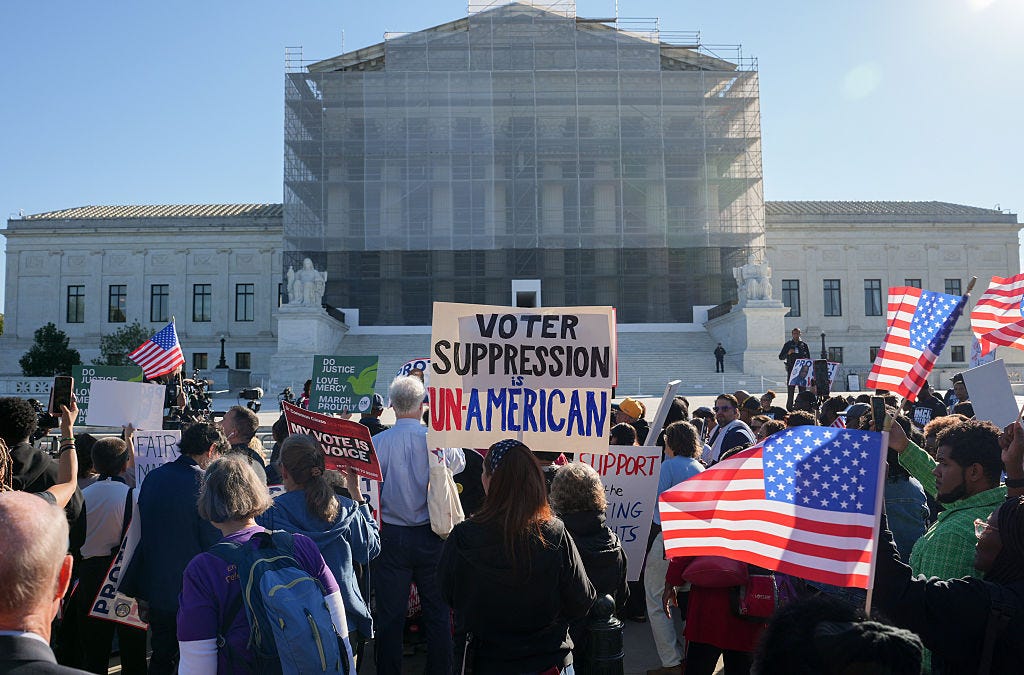
Supreme Court Invalidates Louisiana Congressional Map in Voting Rights CaseMathieu Landretti / Wikimedia (CC BY-SA 4.0)
Audio version
Tap play to generate a narrated version.

The U.S. Supreme Court ruled 6-3 on April 30, 2026, in Louisiana v. Callais, finding that Louisiana's congressional map violated the Equal Protection Clause of the 14th Amendment by predominantly using race in drawing a second majority-Black district.

Justice Samuel Alito's majority opinion stated that the map "impermissibly sorted voters on the basis of race" and clarified the application of Section 2 of the Voting Rights Act, requiring plaintiffs to demonstrate that a state's electoral system results in unequal opportunities for minority voters, with evidence including illustrative maps that comply with traditional districting criteria without prioritizing race.

The decision built on the 1986 Thornburg v. Gingles framework, emphasizing that Section 2 claims must show more than disparate impact and include "strong grounds" for inferring intentional discrimination under the totality of circumstances.

The ruling has prompted discussions in several states about potential mid-decade redistricting. In Florida, the state legislature approved a new congressional map on May 1, 2026, which could result in Republicans holding 24 of 28 seats, according to an analysis by the Associated Press cited in CBS News.

Virginia's legislature passed a map on April 28, 2026, projected to give Democrats 10 of 11 seats, per the same CBS News report. In Tennessee, Republican Rep. Diana Harshbarger stated in a May 2, 2026, interview with Just the News that the decision "opens the door" to redrawing the map to eliminate the state's sole Democratic-held majority-Black district in Memphis.

" He urged Tennessee Gov. Bill Lee to act before the fall elections.

Democratic responses included calls for counter-redistricting in states they control. Rep. " Rep. Terri Sewell suggested to ABC News on April 30, 2026, that California could redraw its 52 seats and Illinois its 17 to favor Democrats. House Minority Leader Hakeem Jeffries described the situation as "maximum warfare, everywhere, all the time" in a statement to the Washington Monthly on May 1, 2026.


In Florida, state Rep.

Civil rights advocates expressed concerns about representation. Damon Hewitt, president of the Lawyers' Committee for Civil Rights Under Law, told the Boston Globe on May 1, 2026: "Black Americans have never been fully represented in the electoral process.

Other perspectives highlighted the ruling's alignment with constitutional principles.

The decision addresses tensions between the Voting Rights Act and constitutional limits on racial gerrymandering, preserving Section 2's core but requiring plaintiffs to provide alternative maps that achieve proportional representation without race as the predominant factor.

A New York Times analysis from 2025, referenced in their April 30, 2026, article, noted that only 8% of congressional races were decided by fewer than 5 percentage points. Associated Press data from 2024, cited in the Boston Globe on May 1, 2026, showed more than three-quarters of state legislative primary races were uncontested.

No publicly released statements from the U.S. Department of Justice on the ruling were available as of May 2, 2026, per the source materials. Election lawyers quoted in CBS News on April 30, 2026, anticipate legal challenges as states apply the new standards, with potential effects on the 2026 midterms.

Key Facts

6-3 decision
invalidated Louisiana's majority-Black district
Section 2 adjustment
focuses on intentional discrimination inferences
Florida map
gives GOP 24 of 28 seats
8% close races
congressional contests decided by under 5 points
Mid-decade redraws
prompted in multiple states for 2026 midterms

Story Timeline

6 events
  1. May 2, 2026

    President Donald Trump urged Tennessee Gov. Bill Lee to redraw maps for an extra GOP seat.

    1 sourceBoston Globe
  2. May 1, 2026

    Florida approved a new congressional map favoring Republicans with 24 of 28 seats.

    2 sourcesBoston Globe · CBS News
  3. Apr 30, 2026

    Supreme Court issued 6-3 ruling in Louisiana v. Callais, striking down the state's map.

    8 sourcesBoston Globe · New York Times · City Journal
  4. Last week

    Virginia passed a map likely giving Democrats 10 of 11 congressional seats.

    1 sourceBoston Globe
  5. 2025

    President Trump initiated mid-decade gerrymandering by asking Texas to redraw maps.

    1 sourceBoston Globe
  6. 1986

    Supreme Court established tests in Thornburg v. Gingles for Voting Rights Act cases.

    2 sourcesCity Journal · Boston Globe

Potential Impact

  1. 01

    States will redraw maps reducing competitive districts before 2026 midterms.

  2. 02

    Congressional delegations will distort states' partisan vote shares.

  3. 03

    Minority representation will decrease in Southern states eliminating majority-Black districts.

  4. 04

    Partisan primaries will decide more elections than general votes.

  5. 05

    Legal challenges will increase as parties test new VRA guidelines.

  6. 06

    Local elections for judges and school boards will see reduced minority influence.

Transparency Panel

Sources cross-referenced12
Framing risk32/100 (low)
Confidence score97%
Synthesized bySubstrate AI
Word count752 words
PublishedApr 29, 2026, 7:21 PM
Bias signals removed8 across 4 outlets
Signal Breakdown
Loaded 3Amplifying 2Speculative 2Editorializing 1

Related Stories

North Korea Updates Constitution, Omits Korean Unification References Amid International Trade FairUser:Langley16 / Wikimedia (CC BY-SA 4.0)
politics1 hr ago

North Korea Updates Constitution, Omits Korean Unification References Amid International Trade Fair

North Korea has revised its constitution to eliminate references to unification with South Korea. The country also opened the Pyongyang Spring International Trade Fair on Monday, showcasing domestic products like the Jindallae smartphone. More than 290 enterprises from several na…

Reuters
South China Morning Post
Japan Times
3 sources
U.S. Pauses One-Day Ship Guidance in Strait of Hormuz as Iran Talks Advancechannelnewsasia.com
politics5 hrs agoDeveloping

U.S. Pauses One-Day Ship Guidance in Strait of Hormuz as Iran Talks Advance

President Trump announced a pause in the one-day-old effort to guide ships out of the Strait of Hormuz, citing progress toward an agreement with Iran. Secretary of State Marco Rubio declared the war with Iran concluded after a month-old cease-fire. The U.S. blockade remains in pl…

The New York Times
National Review
2 sources
Trump Signs Memorandum to Revive Presidential Physical Fitness Award at White House EventOffice of White House Press Secretary / Wikimedia (Public domain)
politics3 hrs agoDeveloping

Trump Signs Memorandum to Revive Presidential Physical Fitness Award at White House Event

President Donald Trump signed a memorandum on May 5, 2026, restoring the Presidential Physical Fitness Award and reintroducing a competitive fitness test in U.S. schools. The event featured student athletes on the White House South Lawn, where Trump demonstrated his signature dan…

Fox News
ABC News
2 sources