world
Swiss Researchers Test ANYmal Robot for Autonomous Exploration on Moon and Mars
Researchers at the University of Basel have tested a four-legged robot named ANYmal in a simulated Mars and Moon environment. The robot performed autonomous missions to identify and analyze rocks, completing tasks in 12 to 23 minutes compared to 41 minutes for human operators.
Apr 9, 4:18 AM·2m read1 source
 Euronews
Audio version
Tap play to generate a narrated version.
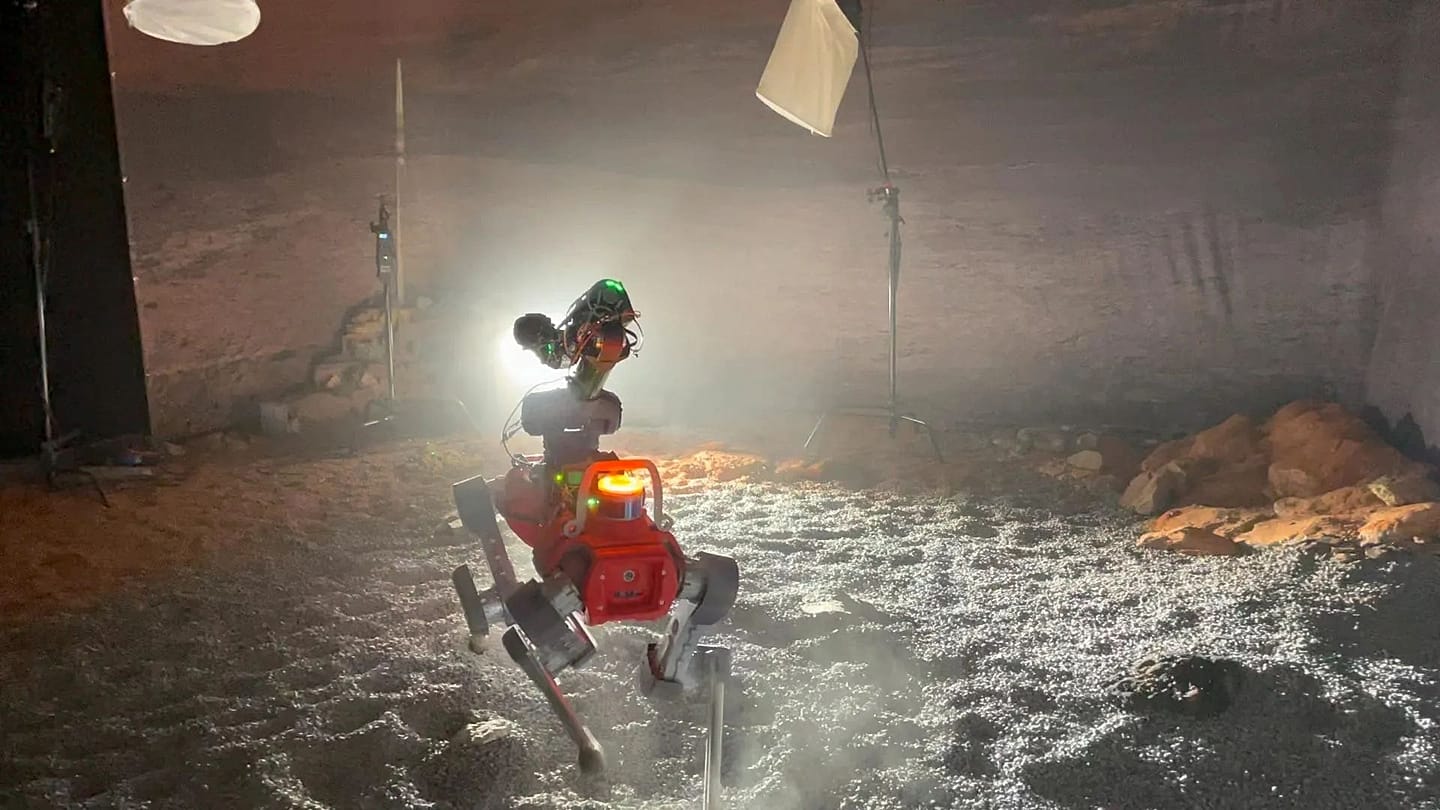
Researchers at the University of Basel in Switzerland have conducted trials of a semi-autonomous four-legged robot named ANYmal, designed for exploration on Mars and the Moon. The robot, which resembles a dog, is equipped with a robotic arm carrying a microscopic imager and a Raman spectrometer to identify chemical compositions of rocks.
These tests occurred at the university's Marslabor, a facility simulating the dusty and rocky surfaces of Mars and the Moon.
The objective of the trials was for ANYmal to navigate independently, identify rocks of scientific interest, analyze them, and transmit results without human guidance. In the experiments, the robot successfully analyzed multiple rocks, including gypsum, carbonates, basalts, dunite, and anorthosite. These materials represent sulfate minerals, lunar-analogue rocks, and common planetary formations.
The trials, detailed in a study published in Frontiers in Space Technologies, showed ANYmal completing missions in 12 to 23 minutes autonomously.
Human operators performing the same tasks took 41 minutes. Human oversight resulted in slightly more detailed analyses and marginally higher accuracy. Current Mars rovers, such as those operated by NASA, function under near-constant supervision from Earth and cover only a few hundred meters per day.
The ANYmal tests highlight how autonomous robots could increase exploration efficiency by enabling independent scientific decisions. Legged robots like ANYmal can step over obstacles and navigate variable terrain, accessing areas unreachable by wheeled rovers.
exploration seeks minerals, water, and traces of ancient life on Mars, the Moon, and potentially exoplanets.
Autonomous systems could accelerate these searches by reducing reliance on Earth-based control, which faces communication delays of up to 20 minutes for Mars. The study positions legged robots as potential active participants in scientific missions, capable of detecting biosignatures—chemical indicators of past life.