Tennessee Doctor Aligns IVF Practice With Christian Beliefs on Embryos
A reproductive endocrinologist in Knoxville, Tennessee, changed his medical practice in 2018 to stop discarding embryos, limit their creation, and avoid genetic testing. The clinic draws patients nationwide who share concerns about conventional IVF methods. The doctor continues to offer infertility treatment while incorporating prayer and embryo adoption options.
 Abc News
A reproductive endocrinologist in Knoxville, Tennessee, altered his approach to in vitro fertilization after developing concerns about the creation and handling of embryos. Dr. John Gordon had practiced for 30 years before concluding that helping to create surplus embryos, which often remained in storage or were discarded, posed moral problems.
He also grew troubled by the expansion of genetic testing that allowed selection based on sex or milder impairments such as hearing loss in addition to serious diseases. In 2018 his wife encouraged him to change how he practiced, citing their shared belief in the sanctity of embryos. He purchased an existing practice in Knoxville and reoriented it as Rejoice Fertility.
The clinic does not discard viable embryos, does not perform genetic testing on them, does not donate them to science, and limits the number created in each cycle. The changes occurred alongside broader public debate over IVF. Recent court rulings have raised questions about the legal status of embryos, including the U.S.
Supreme Court decision ending federal abortion rights and an Alabama Supreme Court ruling that designated embryos as children. Polling shows IVF remains widely popular, and President Donald Trump has taken steps to expand access to it. Rejoice Fertility draws patients from around the country.
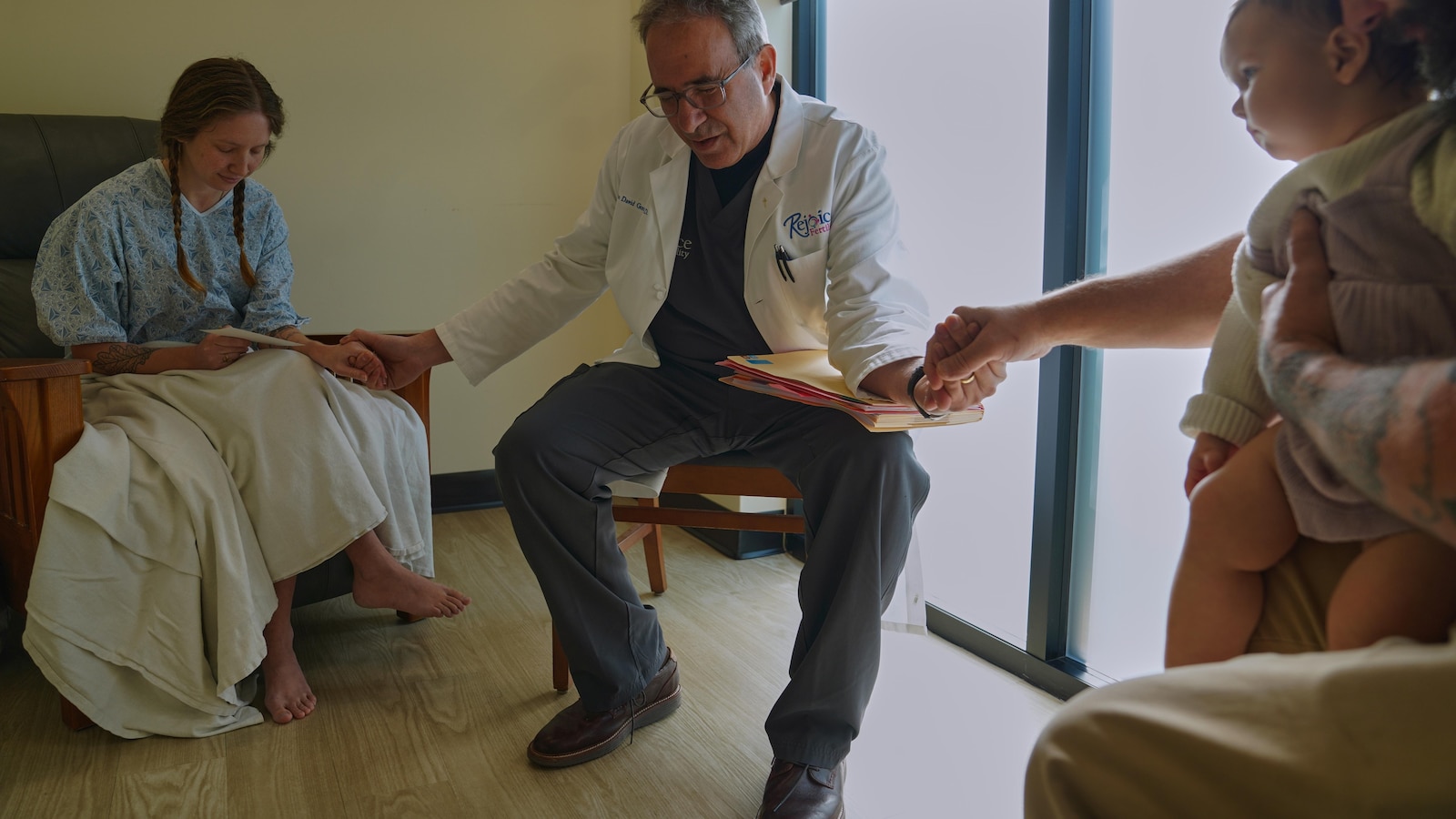
The waiting room contains evangelical brochures and a wooden cross. The clinic does not require employees or patients to share the doctor's religious beliefs. Patients have cited the clinic's policies as aligning with their faith.
They said they appreciated that the clinic does not genetically test or discard embryos. "You're still letting God be God," Maggie Lichfield said.
Domenic and Olivia D'Agostino drove nearly two hours to reach the clinic after deciding against conventional IVF for religious reasons. They had not known that a facility avoiding embryo discard existed. "That was the biggest one for me because in my eyes there's not much difference between discarding an embryo and abortion," Domenic D'Agostino said.
He added that the doctor prays with patients before transfers, a practice the couple values. He met his wife at Duke.
After their oldest son recovered from a life-threatening illness, the couple joined a Presbyterian church and the doctor was baptized in 2000. They now belong to a congregation in the Presbyterian Church in America. His wife oversees the laboratory at Rejoice Fertility.
The lab accepts embryos in nearly any condition. The clinic once provided care for an embryo frozen for nearly 31 years; the child born in 2025 is believed to hold the record for longest-frozen embryo to result in a live birth. The doctor tailors treatment to patients' desired family size and offers cycles that use less medication, which tends to produce fewer eggs and lower costs.
Patients may also choose to fertilize fewer eggs. These options exist at other clinics but receive unusual emphasis at Rejoice Fertility. A cycle at the clinic typically costs between $8,000 and $10,000.
Some patients require additional cycles if the limited number of embryos does not result in pregnancy. Emily Martin, a patient in Knoxville, said she wishes she had used the clinic earlier after being left with embryos in storage from treatment elsewhere. In cases where patients have unused embryos, the doctor encourages placement for adoption.
The clinic stores donated embryos and coordinates with Christian agencies that arrange embryo adoptions. One couple from Georgia adopted an embryo frozen for 11 years through the clinic's network. When the first transfer did not produce a pregnancy they later adopted two more.
The doctor has faced criticism from some Christians and anti-abortion activists who view all IVF as unethical. He plans to add more physicians to the practice. One recent Sunday after church services, laboratory staff prepared a frozen embryo for transfer to a couple from North Carolina.
The embryo thawed and its cells rehydrated in a culture dish. Four weeks after the transfer, the patient was reported to be pregnant.
Key Facts
Story Timeline
4 events- 2000
Gordon was baptized after a conversion experience.
1 sourceAbc News - 2018
Gordon purchased a practice in Knoxville and aligned it with his faith-based views on embryos.
1 sourceAbc News - 2025
A child was born from an embryo frozen nearly 31 years at Rejoice Fertility.
1 sourceAbc News - 2026
A North Carolina couple achieved pregnancy four weeks after an embryo transfer at the clinic.
1 sourceAbc News
Potential Impact
- 01
Patients may incur costs of additional IVF cycles when fewer embryos are created.
- 02
Patients seeking faith-aligned IVF travel to Knoxville from other states.
- 03
The clinic coordinates embryo adoptions with Christian agencies.
- 04
Some patients report reduced moral distress from embryo storage or disposal.
Transparency Panel
Related Stories
 Stat
StatNYU Langone Receives Federal Grand Jury Subpoena on Gender-Affirming Care for Minors
NYU Langone Health disclosed last week that it received a grand jury subpoena from the U.S. Attorney’s Office in the Northern District of Texas seeking records on minors who received gender-affirming care from 2020 to 2026. The request marks a shift from prior administrative subp…
 The Bbc
Marty Makary Resigns as FDA Commissioner
President Donald Trump confirmed the departure of Marty Makary, who had served as FDA commissioner since March 2025. Kyle Diamantas, the agency's top food regulator, will step in as acting commissioner. Makary is the latest top health official to leave under Health and Human Serv…
 mg.co.za
11 Cases of Andes Hantavirus Confirmed Among Passengers on Dutch Cruise Ship
The Andes strain of hantavirus, capable of person-to-person transmission and not found locally in the U.S., has infected 11 passengers on a Dutch cruise ship, forcing international travelers into quarantine. NBC News reported the outbreak draws on lessons from past clusters inclu…