Trump and Xi Meet at Beijing Summit
U.S. President Donald Trump and Chinese President Xi Jinping wrapped up two days of talks in Beijing on May 15, 2026. The leaders discussed trade deals, the war with Iran, reopening the Strait of Hormuz, and tensions over Taiwan. American business leaders accompanied Trump, and officials expect China to make major agricultural purchases.
 ABC News
U.S. President Donald Trump and Chinese President Xi Jinping concluded their two-day summit in Beijing on Friday after holding a second round of talks that covered trade, the ongoing war with Iran and tensions over Taiwan. Trump said the two leaders feel "very similar on Iran" and both want the conflict to end while preventing Iran from obtaining a nuclear weapon.
He added that they want the Strait of Hormuz reopened after it was closed during the fighting. The Chinese Foreign Ministry sidestepped direct confirmation of the Iran discussions but called for continued ceasefire and negotiations, stating that finding a solution earlier benefits all parties.
" Trump said the meetings produced agreements that include China purchasing tens of billions of dollars worth of American agricultural products annually over the next three years. Xi warned Trump during the first day of talks that mishandling the issue of Taiwan could lead to "clashes and even conflicts" between the United States and China.
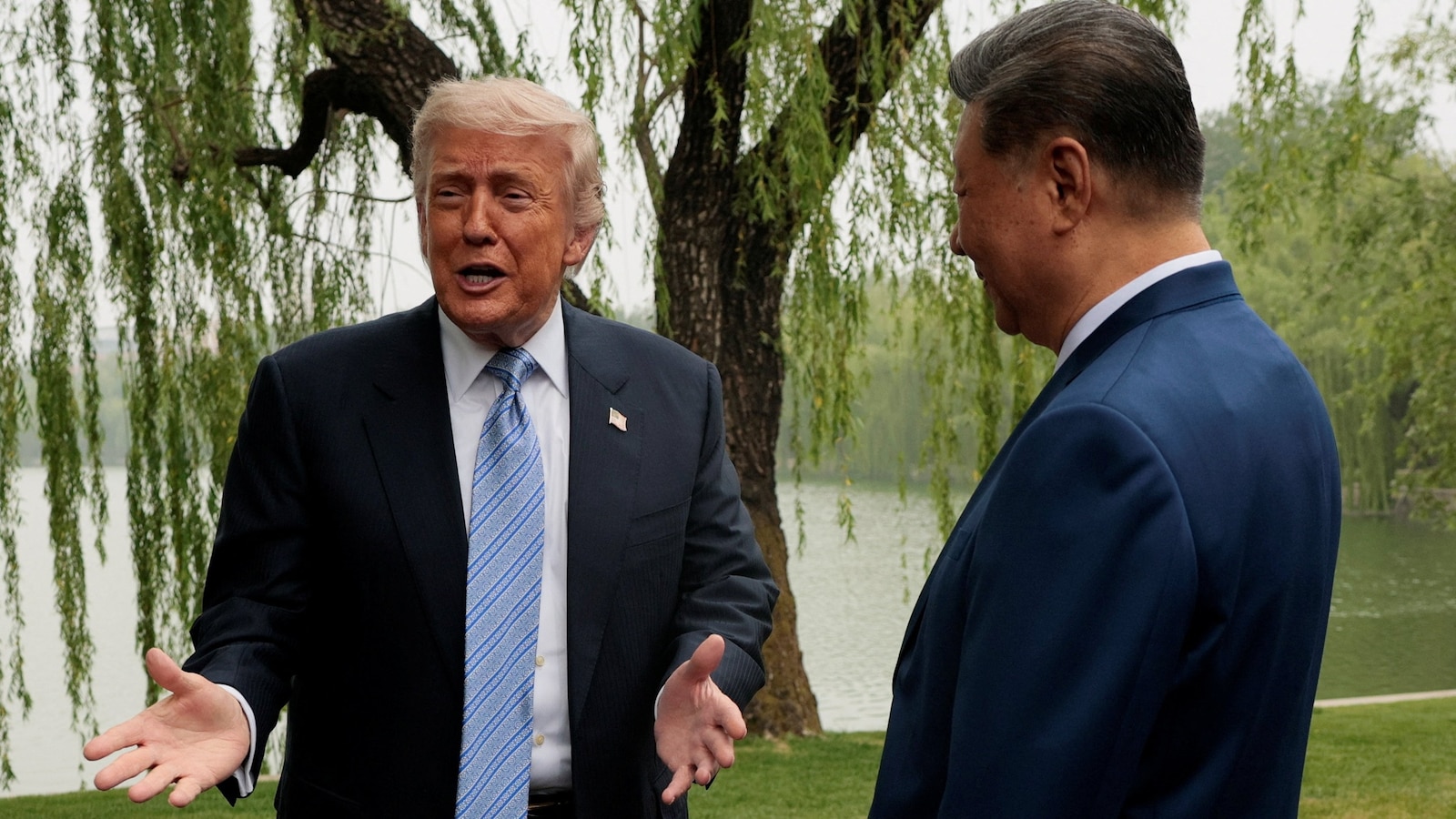
He added that proper handling of the matter would allow bilateral relations to remain generally stable. The warning came as Trump sought to ease tensions amid the summit that also addressed global conflicts. Before their working lunch on Friday, the leaders toured the Zhongnanhai Garden.
Xi chose the location to reciprocate hospitality Trump extended during a 2017 visit to Mar-a-Lago. Xi agreed to gift Trump seeds from Chinese roses that interested the U.S. president during the garden tour. A delegation of American business leaders traveled with Trump to Beijing.
The group included executives from major technology and automotive companies who joined to help secure purchasing agreements in aerospace, agriculture and energy sectors. Asian markets showed mixed performance Friday as investors monitored the summit's outcome.
South Korea's Kospi index fell more than 6 percent to close at 7,493.18 after briefly hitting a record high above 8,000. Japan's Nikkei 225 declined 2 percent while Hong Kong's Hang Seng index dropped 1.6 percent. In the United States, Wall Street closed at fresh record highs on Thursday after strong earnings from one major technology company.
The Dow Jones Industrial Average rose 0.75 percent to end above 50,000 while the S&P 500 gained 0.77 percent.
Trump emphasized that the business leaders joined the trip to "pay respects" to Xi and China while looking forward to reciprocal trade. Officials from the U.S. side said one goal of the summit was to secure concrete purchasing commitments from China in several key sectors.
The U.S. Trade Representative told Bloomberg that the administration expects an agreement for double-digit billion dollar purchases of American agricultural goods per year over the next three years. The purchases would cover a range of products beyond just soybeans.
Xi delivered a stark message on Taiwan at the start of the summit. According to China's state broadcaster, he told Trump that improper handling of the Taiwan issue could place the entire bilateral relationship in great jeopardy. Xi also stated that China and the United States both stand to gain from cooperation and lose from confrontation.
He urged the two countries to act as partners rather than rivals and to help each other succeed.
“We feel very similar on Iran. We want that to end. We don't want them to have a nuclear weapon. We want the Strait of Hormuz opened.”
“If the issue of Taiwan is handled improperly, the two nations could come into conflict.”
Markets in the region gave up earlier gains amid the developments. Precious metals also declined with spot gold falling 1.43 percent to $4,583.02 per ounce and silver dropping more than 5 percent. Trump departed Beijing after the meetings and is heading back to the United States.
The summit occurred as the U.S. continues its involvement in the war with Iran and pushes for reopening the Strait of Hormuz, a critical waterway for global oil transport.
Key Facts
Story Timeline
5 events- May 14, 2026
Trump and Xi began summit with meetings at Great Hall of the People and state banquet.
3 sourcescnbc.com · ABC News · Al Jazeera - May 14, 2026
Xi warned Trump that mishandling Taiwan could lead to clashes or conflict.
2 sourcescnbc.com · ABC News - May 15, 2026
Leaders toured Zhongnanhai Garden before second round of talks.
2 sourcesABC News · @CBSNews - May 15, 2026
Trump stated agreement with Xi on ending Iran war and reopening Strait of Hormuz.
2 sourcesABC News · Al Jazeera - May 15, 2026
Summit concluded with Trump departing Beijing for the U.S.
2 sourcesABC News · cnbc.com
Potential Impact
- 01
China is expected to sign agreements for large-scale purchases of U.S. agricultural goods over three years.
- 02
U.S. stock indexes closed at record highs following positive corporate earnings during the summit period.
- 03
American technology and automotive companies gain direct access to Chinese leadership during the summit.
- 04
U.S. and Chinese officials will continue negotiations on reopening the Strait of Hormuz.
Transparency Panel
Related Stories
 ibtimes.com
SEC Chair Paul Atkins Says Congress Will Pass Crypto Legislation
SEC Chair Paul Atkins stated he is confident Congress will pass crypto market structure legislation. He added that President Trump will sign the bill into law.
 asiaone.com
Iran Says Strait of Hormuz Management Belongs to Iran and Oman
Iran's Foreign Ministry spokesperson stated that control of the Strait of Hormuz must be decided solely by Iran and Oman. The spokesperson also said no agreement has been reached with the United States and that current focus remains on ending the war.
 cnbc.com
Fed Official Highlights Regulatory Barriers to AI Productivity Gains
A Federal Reserve official stated that productivity growth remains key to economic expansion and that regulatory hurdles are the main obstacle to sustained gains from artificial intelligence.