politics
Trump and Xi Jinping Hold Bilateral Meeting in Beijing
President Donald Trump arrived in Beijing on Wednesday evening and held two-hour talks with Chinese leader Xi Jinping at the Great Hall of the People. The leaders discussed trade, Iran and Taiwan as Trump was accompanied by chief executives from major U.S. tech and business firms. The visit, originally planned for March, was rescheduled after U.S. and Israeli attacks on Iran.
May 14, 5:05 AM·2m read6 sources

 +3
+3
 Nbc News
Audio version
Tap play to generate a narrated version.
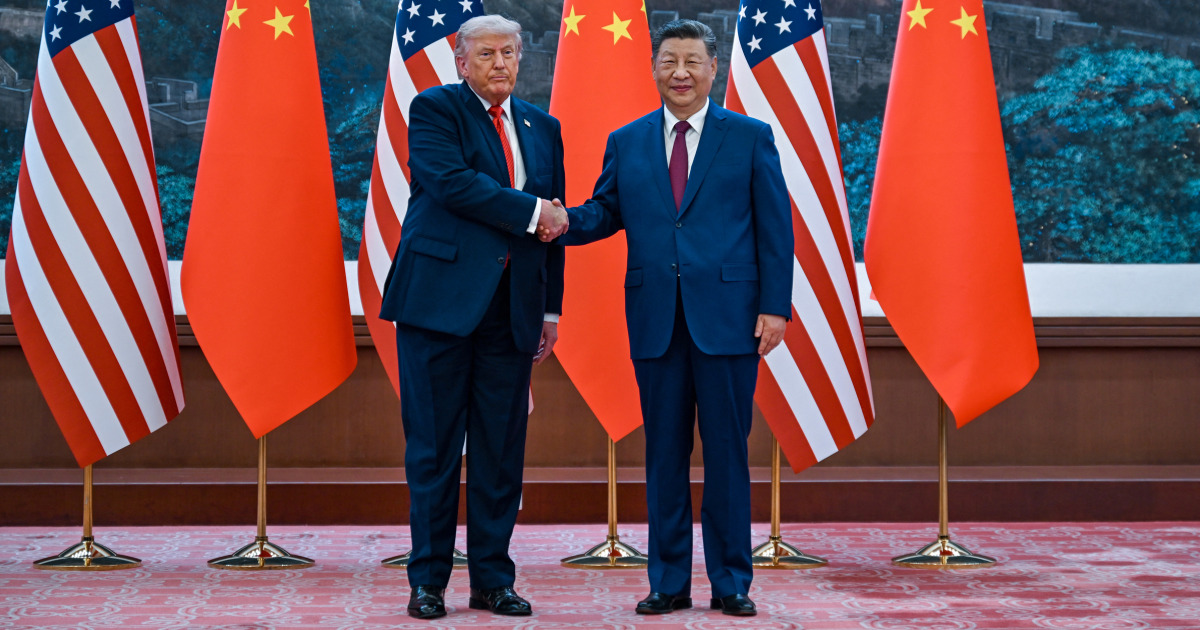
U.S. leader to China since his own trip in 2017. He received a spectacular welcome at the Great Hall of the People, where he and Xi Jinping shook hands on the red carpet before entering a room for their bilateral meeting.
The talks lasted around two hours, longer than expected. " He said he would ask Xi to "open up" China's economy to major tech companies and that he expected a "long talk" about Iran. Trump insisted he did not need China's help to end the conflict with Iran, though he said Xi had been "relatively good" on Iran.
Xi told Trump that Taiwan was the most important issue in their relationship. U.S. must "exercise extra caution" regarding the self-governed island.
U.S. and Israel launched attacks on Iran. Trump and Xi last met in South Korea in October 2025. U.S.
Businesses and tech companies. Nvidia CEO Jensen Huang, who was personally invited by Trump and joined the trip after a stopover in Alaska, Apple CEO Tim Cook, Elon Musk, BlackRock CEO Larry Fink, and executives from Meta, Visa, JP Morgan, Boeing, and Cargill are all part of the delegation. After the bilateral meeting, Trump and Xi took a tour to the Temple of Heaven.
A state banquet was scheduled to be held later on Thursday. On Friday, Trump will visit Zhongnanhai, where the visit will feature a "friendship photo" and handshake with Xi. The leaders' discussions come against a backdrop of tense trade relations between the two superpowers.
U.S. industries. U.S. consumer market.
U.S. and China. Despite Trump's insistence that he did not need China's help with Iran, he is expected to encourage Beijing to convince Tehran to make a deal.
China is eager for an end to the war as the conflict causes pain to its sluggish economy heavily reliant on exports. Artificial intelligence is another major issue for the two superpowers, with rivalry compared to a nuclear arms race. Both sides are seeking channels of communication to avoid conflict.