world
Typhoon Bavi Kills 17 in Philippines, Makes Landfall in Eastern China
Typhoon Bavi struck China's eastern Zhejiang province late Saturday with 144 kph winds. Authorities had already moved nearly two million people from high-risk areas in eastern China.
Jul 11, 3:44 PM·1m read11 sources
 AB+8
AB+8
 arynews.tv
Audio version
Tap play to generate a narrated version.
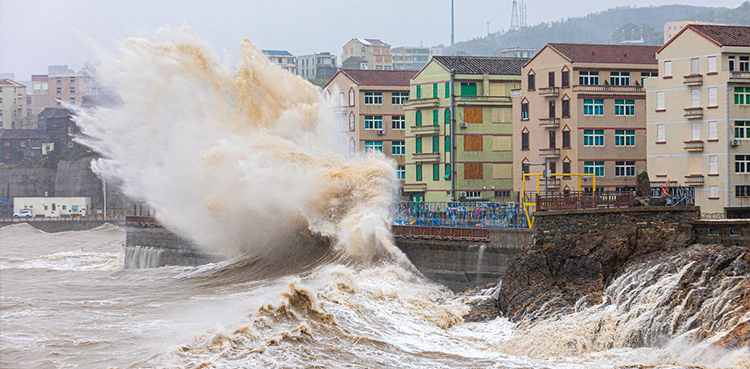
Typhoon Bavi made landfall late Saturday in China's eastern Zhejiang province, first striking the coastal city of Yuhuan before a second landfall near Wenzhou around midnight. The storm carried maximum sustained winds of 144 kph near its center and spanned roughly 1,000 km at its widest point.
Chinese authorities evacuated more than 1.7 million people from Zhejiang province by Saturday morning, with nearly two million total moved from high-risk areas in eastern China.
Shanghai relocated 34,000 residents from vulnerable zones by noon, while Ningde in Fujian province shifted more than 3,700 people by Friday evening. Officials placed over 17,000 emergency workers on standby in Fujian and allocated 40 million yuan in central relief funds to the two provinces.
Bavi began as a super typhoon with 290 km/h winds that battered Guam and the Northern Mariana Islands on July 6.
It weakened to 144 km/h when it crossed Japan's Sakishima islands, injuring five people and leaving thousands without power. More than 200 flights were cancelled across Japan's Okinawa prefecture. Landslides triggered by monsoon rains intensified by Bavi killed at least 17 people in the southern Philippines before dawn on Friday.
One slide in Malapatan, Sarangani province, killed 10 villagers and left three missing, while another in Calanogas, Lanao del Sur province, killed five and left six missing. Two additional deaths occurred from flooding in Bukidnon province on Wednesday, and about 11,000 villagers moved into 77 emergency shelters.
China's National Meteorological Center issued an orange typhoon alert and the year's first red rainstorm alert.
Schools, work, and ferry services were suspended in Zhejiang, where 400 flights and dozens of train services were cancelled. Bavi follows Typhoon Maysak, which made landfall in southern China on July 3 and left at least 39 people dead. The storm is expected to move northwestward inland with gradually weakening intensity.

