UN Nuclear Nonproliferation Treaty Review Conference Opens; U.S., Iran Clash on Nuclear Program
The 11th Review Conference of the Nuclear Nonproliferation Treaty opened on April 27, 2026, at the United Nations in New York, with Iran elected as a vice president amid clashes over its nuclear program. U.S. officials criticized the election and Iran's treaty compliance, while Iranian representatives accused the U.S. of violations and aggression. The monthlong meeting reviews the 1970 treaty's im
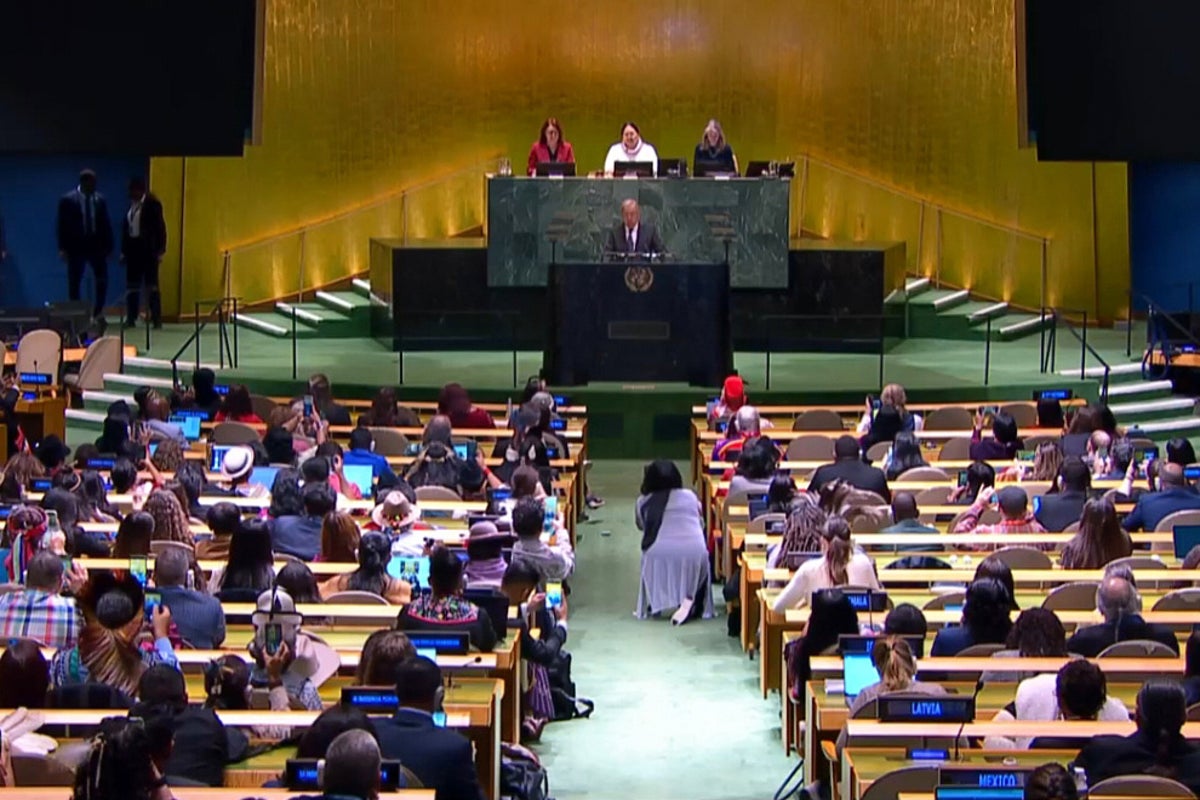
yna.co.krThe 11th Review Conference of the Nuclear Nonproliferation Treaty began on Monday, April 27, 2026, at the United Nations in New York, where Iran was elected as one of 34 vice presidents of the conference. Representatives from the United States and Iran lashed out during speeches at the UN, highlighting tensions over Tehran's nuclear program that escalated ahead of the Iran war.
The conference reviews the implementation of the Nuclear Nonproliferation Treaty, which has 191 parties and took effect in 1970, with such reviews occurring every five years.
Iran, a party to the Nuclear Nonproliferation Treaty, was a candidate of the nonaligned movement, made up of 121 mainly developing countries. President Donald Trump vowed to ensure Iran cannot build an atomic weapon.
S. lifted its blockade of Iranian shipping and ended the war, while delaying talks about the nuclear program. N. nuclear agency. S. last June. S. assistant secretary of state for arms control and nonproliferation, said that Iran has shown contempt for its commitments under the treaty.
“Rather than choosing to use this review conference to defend the integrity of the NPT and call Iran to account, we instead elect Iran a vice president. It is beyond shameful and an embarrassment to the credibility of this conference,” the U.S. official said. The United States was backed by Australia and the United Arab Emirates in its position.
The United Kingdom, France, and Germany expressed concern over Iran's nuclear program. The United Kingdom, France, and Germany are parties to the 2015 nuclear deal to curb Iran's nuclear program. U.S. from the 2015 nuclear deal in 2018.
Iranian representatives called U.S. allegations baseless and politically motivated. Iranian official said the United States was the only country to use nuclear weapons. The official accused the United States of expanding its nuclear arsenal in violation of the treaty.
The official accused the United States of obstructing progress toward a Middle East free of nuclear weapons by supporting Israel. U.S. and Israeli attacks twice in less than a year on Iran’s peaceful nuclear facilities are a grave violation of international law and a direct assault on the integrity of the global nonproliferation regime,” the official said.
Russian Ambassador-at-Large Andrey Belousov, head of Russia's delegation, objected to singling out Iran. Belousov expressed hope that the criticism and politicization starting on day one will not affect the outcome of the conference. Iranian Foreign Minister Abbas Araghchi met with Russian President Vladimir Putin on Monday, April 27, 2026, according to Tass.
At the last treaty review conference in August 2022, which was delayed for a year because of the COVID-19 pandemic, Russia blocked agreement on a final document. Russia blocked agreement over its February 2022 invasion of Ukraine and references to Moscow’s occupation of the Zaporizhzhia nuclear plant and shelling at Europe’s largest nuclear power facility.
Secretary-General António Guterres urged the treaty parties to stand together and safeguard humanity from the grave threat of nuclear annihilation. Guterres said that for the first time in decades, the number of nuclear warheads is rising and nuclear testing is on the table.
Guterres urged countries in the new technological era of artificial intelligence and quantum computing to ensure that, until nuclear weapons are eliminated, humanity never cedes control over their use.
China, Russia, Britain, and France—agreed to negotiate toward eliminating their arsenals someday. Under the Nuclear Nonproliferation Treaty, nations without nuclear weapons promised not to acquire them in exchange for a guarantee to be able to develop nuclear energy for peaceful purposes.
France’s Foreign Minister Jean-Noel Barrot told signatories that never has the risk of nuclear proliferation been so high and the threat posed by Iran’s and North Korea’s programmes is intolerable for each and every state party to this treaty.
North Korea withdrew from the Nuclear Nonproliferation Treaty in 2003. North Korea's nuclear arsenal is now estimated at several dozen warheads, according to figures released by the International Atomic Energy Agency.
Key Facts
Story Timeline
6 events- 2026-04-27
The 11th Review Conference of the Nuclear Nonproliferation Treaty began at the United Nations in New York; Iran elected as vice president; U.S. and Iran representatives exchanged accusations; Iranian Foreign Minister Abbas Araghchi met with
4 sourcesThe Independent · washingtontimes.com · South China Morning Post · Le Monde - 2026-04-15
International Atomic Energy Agency released figures estimating North Korea's nuclear arsenal at several dozen warheads
1 sourceLe Monde - 2025-06-22
U.S. strikes caused damage to the nuclear enrichment site in Isfahan, Iran
1 sourceLe Monde - 2022-08
Last treaty review conference held, delayed by COVID-19; Russia blocked final document over Ukraine invasion references
2 sourcesThe Independent · South China Morning Post - 2022-02
Russia invaded Ukraine, leading to occupation of Zaporizhzhia nuclear plant
1 sourceThe Independent - 2018
President Donald Trump pulled the U.S. from the 2015 nuclear deal with Iran
2 sourcesThe Independent · washingtontimes.com
Potential Impact
- 01
Escalation in U.S.-Iran tensions affecting ongoing war and blockade negotiations
- 02
Strengthened alliances, such as Russia-Iran ties demonstrated by ministerial meeting
- 03
Potential failure to reach consensus at the conference, similar to 2022
- 04
Renewed global focus on nuclear disarmament amid rising warhead numbers
- 05
Increased scrutiny on nuclear programs of non-signatories like North Korea
Multi-source corroboration verifies facts, not framing. This panel scores the Substrate rewrite you just read (top score) and the raw source bundle it came from. A positive delta means the rewrite stripped framing from the sources; a negative or zero delta means our neutralizer let some through.
Iran's election as vice president reflects nonaligned nations' push for equitable NPT representation amid US violations like facility strikes.
- Lede misdirectionnotable“TITLE: UN Nuclear Nonproliferation Treaty Review Conference Opens; U.S., Iran Clash on Nuclear Program”Leads with diplomatic clash instead of core event of treaty reviewThe headline leads with who shared, posted, or reacted to the event rather than the substantive event itself — burying the actual news behind the messenger.
- Valence skewminor“Iran has shown contempt for its commitments; It is beyond shameful”Negative loaded language targets Iran via U.S. official quoteAdjectives and adverbs systematically slant toward one interpretation even though the underlying facts are neutral.
- Selective sourcingminor“U.S. backed by Australia and UAE; UK, France, Germany expressed concern”Western allies' criticisms dominate without equal counterbalanceEvery quoted expert shares one viewpoint; no counter-expert is given meaningful space.
Transparency Panel
Related Stories
winnipegfreepress.comMexican Military Captures Top Jalisco Cartel Leader Audias Flores Silva
Mexican forces arrested Audias Flores Silva, a high-ranking member of the Jalisco New Generation Cartel and potential successor to its slain leader, in Nayarit state. The capture follows the February killing of Nemesio Oseguera Cervantes and comes amid ongoing efforts to combat c…
Appeals Court Allows Pentagon Escort Requirement for Reporters During Appeal
A U.S. appeals court ruled that the Defense Department can require journalists to be escorted on Pentagon grounds while appealing a lower court decision. The ruling suspends a district judge's order blocking the policy. Media organizations, including The New York Times, had chall…
rediff.comUN Secretary-General Warns of Erosion in Nuclear Non-Proliferation Treaty
UN Secretary-General Antonio Guterres stated that the Nuclear Non-Proliferation Treaty is eroding. He added that trust and credibility related to the treaty are wearing thin. The statement highlights ongoing concerns in global nuclear disarmament efforts.