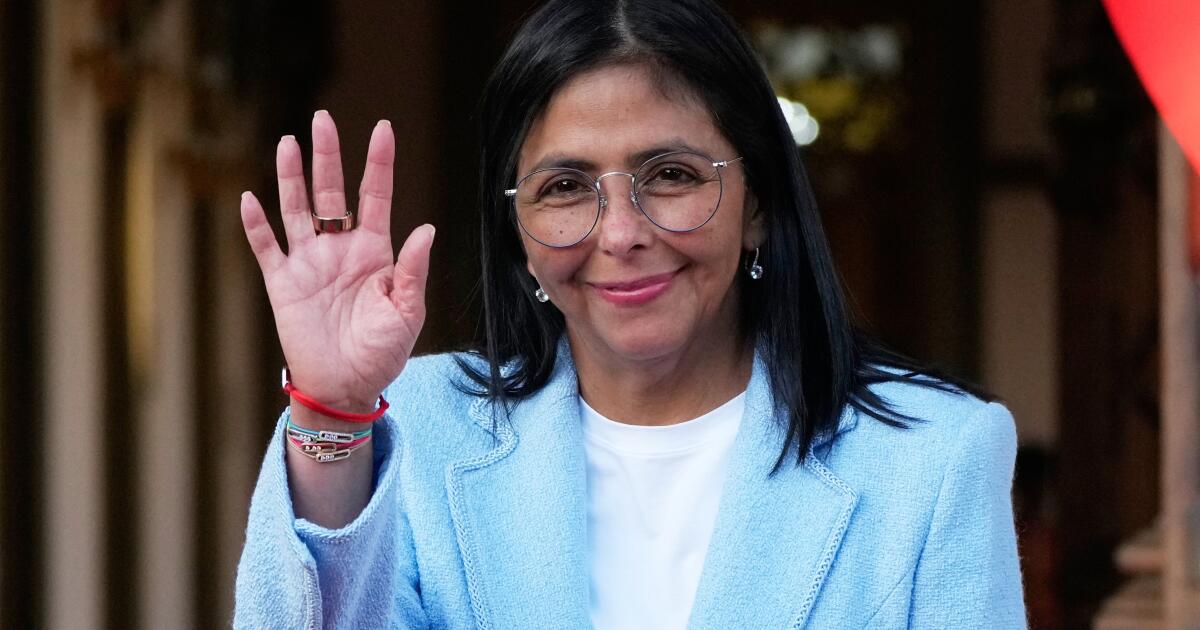
Venezuela Rejects Trump's Suggestion It Become 51st U.S. State
Acting President Delcy Rodríguez told the International Court of Justice on Monday that Venezuela has no intention of becoming a U.S. state after President Trump said he was seriously considering the idea. Rodríguez was in The Hague for the final day of hearings on Venezuela's long-running territorial dispute with Guyana over the oil-rich Essequibo region. She said Venezuelan and U.S.
Los Angeles TimesVenezuela's acting President Delcy Rodríguez rejected any notion that her country would become the 51st U.S. state after President Trump said Monday he was seriously considering the move. Rodríguez made the remarks at the International Court of Justice in The Hague, where hearings concluded in a century-old border dispute with neighboring Guyana over the mineral- and oil-rich Essequibo region.
Rodríguez told journalists that Venezuela would continue to defend its integrity, sovereignty, independence and history. "We are not a colony, but a free country," she added. She also said Venezuelan and U.S.
officials have been in touch and are working on cooperation and understanding. Trump made the comment about Venezuela during an interview with Fox News that aired Monday. The White House did not immediately respond to a request for comment.
Trump has previously made similar remarks about Canada. Before addressing Trump's statement, Rodríguez defended Venezuela's claim to the 62,000-square-mile Essequibo territory, which comprises two-thirds of Guyana. The area is rich in gold, diamonds, timber and sits near massive offshore oil deposits currently producing an average of 900,000 barrels a day.
That output is close to Venezuela's daily production of about 1 million barrels. Venezuela has considered Essequibo its own since the Spanish colonial period. An 1899 arbitration decision by Britain, Russia and the United States drew the border largely in favor of Guyana.
Venezuela argues a 1966 Geneva agreement to resolve the dispute nullified the 19th-century arbitration. In 2018, after ExxonMobil announced a significant oil discovery off the Essequibo coast, Guyana asked the International Court of Justice to uphold the 1899 ruling. The court is expected to take months to issue a final ruling.
Rodríguez told the judges that political negotiations, not a judicial decision, will resolve the dispute. She accused Guyana of undermining the 1966 agreement with its "opportunistic" decision to seek a court ruling, which she said coincided with the 2015 oil discovery.
"At a time when the mechanisms established in the Geneva agreement were still fully in force, Guyana unilaterally chose to shift the dispute from the negotiating arena to a judicial resolution," Rodríguez said.
Venezuela has warned that its participation in the hearings does not imply consent to the court's jurisdiction. Tensions escalated in 2023 when Rodríguez's predecessor, Nicolás Maduro, threatened to annex the region by force after a referendum. Maduro was captured on Jan.
3 during a U.S. military operation in Caracas and taken to New York to face drug trafficking charges. He has pleaded not guilty. Rodríguez assumed power following that operation. When hearings opened last week, Guyana's foreign minister Hugh Hilton Todd told the court the dispute has been a blight on Guyana's existence as a sovereign state from the beginning.
He said 70 percent of Guyana's territory is at stake.
“We will continue to defend our integrity, our sovereignty, our independence, our history.”
The developments in The Hague occurred on the same day Trump sharply criticized Iran's response to a U.S. ceasefire proposal related to the ongoing conflict in the Middle East. Trump told reporters the ceasefire with Iran is on "massive life support" and described Tehran's counteroffer as totally unacceptable.
Key Facts
Story Timeline
5 events- May 11, 2026
Delcy Rodríguez rejects Trump's 51st state suggestion at ICJ hearings in The Hague.
3 sourcesLos Angeles Times · Daily Caller - May 11, 2026
Trump tells Fox News he is seriously considering making Venezuela the 51st U.S. state.
4 sourcesLos Angeles Times · Daily Caller - May 11, 2026
Trump describes U.S.-Iran ceasefire as on 'massive life support' after rejecting Tehran's counteroffer.
8 sourcesThe Hill · BBC News · New York Times - Jan 3, 2026
Nicolás Maduro captured during U.S. military operation in Caracas and taken to New York on drug charges.
1 sourceLos Angeles Times - 2023
Maduro threatens to annex Essequibo by force following referendum.
1 sourceLos Angeles Times
Potential Impact
- 01
U.S.-Iran ceasefire remains in place but under severe strain after rejection of latest proposal.
- 02
Ongoing instability in Strait of Hormuz continues to affect global oil transit.
- 03
Guyana maintains control of offshore oil production near disputed border.
- 04
International Court of Justice expected to issue binding ruling on Essequibo in coming months.
- 05
Continued diplomatic contacts between Venezuelan and U.S. officials on cooperation.
Transparency Panel
Related Stories
BBC NewsTrump Meets Advisers to Decide on Iran Ceasefire Extension
President Trump said he is holding a Situation Room meeting to make a final decision on a possible deal with Iran. The proposed agreement would extend the ceasefire by 60 days and reopen the Strait of Hormuz.
Trump to Decide on Iran Deal in Situation Room Meeting
President Trump said Friday he is heading into the Situation Room to make a final determination on a potential agreement with Iran. The proposed deal would reopen the Strait of Hormuz without tolls and require destruction of Iran's highly-enriched uranium.
benzinga.comVietnam Clears Graves for Trump Organization Project in Hung Yen Province
Farmers in Hung Yen province are exhuming family graves to make way for a $1.5 billion Trump Organization development that includes hotels, villas and a golf course. The project, approved last year, has drawn local resistance over compensation levels and relocation of remains.