Unbiased AI-powered news
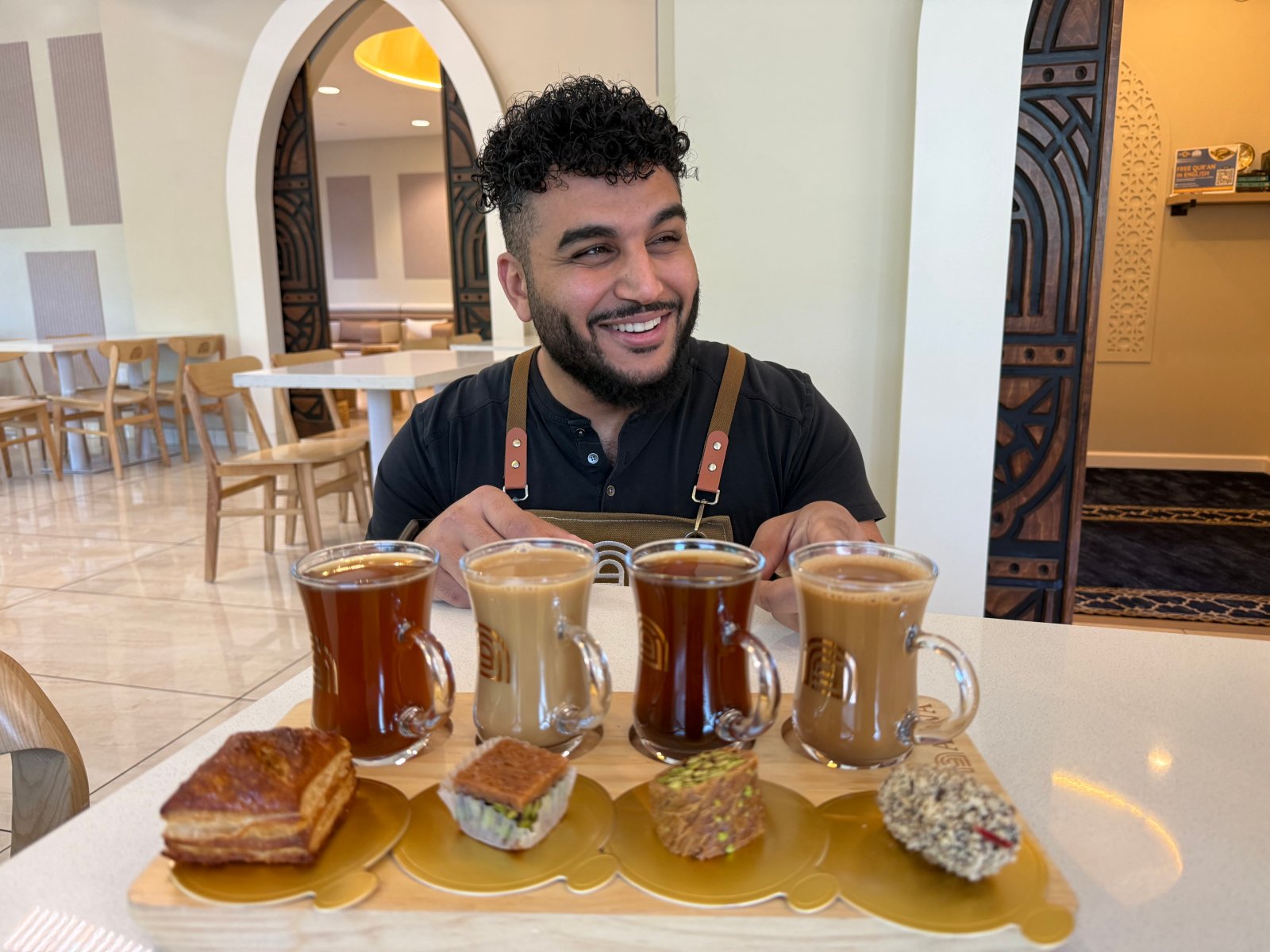
The number of cafes serving Yemeni-style drinks operated by six major chains grew 50% last year to 136. Chains like Arwa Yemeni Coffee and Haraz Coffee House lead the expansion, with locations in states including California, Michigan and Texas. Owners cite cultural preservation and broad customer appeal as drivers.
winnipegfreepress.comThe number of cafes run by six major chains that serve Yemeni-style drinks grew 50% last year to 136. Yemen, a mountainous, war-ravaged country that borders Saudi Arabia and Oman, has seen its coffee culture take root in the United States. Most Yemeni coffee shops cluster in areas with high concentrations of Arab Americans, including Michigan, California and Texas, though new outlets have opened in Alpharetta, Georgia; Overland Park, Kansas; and Portland, Maine.
Ahmad Badr owns an Arwa Yemeni Coffee franchise in Sunnyvale, California. "Generally in the Middle East, our nightlife is coffee, right? People hang out at coffee shops, they play cards, they talk. We wanted to bring that here," Badr said.
U.S. adults reported drinking alcohol, the lowest percentage in 90 years. U.S. population as a whole. U.S. and 30 more in development.
An ongoing civil war in Yemen that began in 2014 has limited travel for Yemeni Americans, prompting efforts to recreate the homeland experience. , and that was a huge passion for us when we opened our first location. It was extremely emotional for all of us due to the fact that it really transported us to Yemen," Almatrahi said.
He noted that most of his customers are not of Arab descent. Yemeni cafes serve specialties like Adeni tea, a spiced tea similar to chai, and qishr, a traditional drink made from the dried husks of coffee cherries. At Arwa, lattes feature the outline of a camel stenciled in spices.
Bakery cases in Yemeni cafes might contain khaliat nahal, or Yemeni honeycomb bread, a cheese-filled pastry drizzled with honey, or basboosa, a cake soaked in sugar syrup and often flavored with lemon or rose water. U.S. coffeeshop fare like matcha lattes or berry refreshers.

U.S. coffee industry for the last few years. He cited the Latin-style chain Tierra Mia in California and Nguyen Coffee Supply, a New York-based company that roasts Vietnamese beans.
Cindy Donovan visited Badr’s shop in Sunnyvale for the first time on a recent weekday. "I think they’re much more refined and mellow, and much more full of flavor than a regular cup of dark roast, for instance. The cardamom in the drinks is fantastic.
Very, very flavorful, rich but not heavy," Donovan said. Yemeni cafes often mix coffee with special spice mixes or hawaij that may contain cardamom, ginger, cinnamon, cloves, coriander or nutmeg.
U.S. outlets and another 50 in development. "Our coffee and teas are not just made through a fully automatic machine.
We have to manually blend and mix our coffee and tea, boil it with water and evaporated milk, make sure that it comes out (with the) perfect taste, perfect color," Nasser said. By the 1400s, coffee was being cultivated in Yemen, where monks brewed it to stay awake during prayers.
Yemen monopolized the coffee trade for around 200 years until Dutch merchants smuggled coffee seeds to Indonesia and began growing plants there.
More than 80% of the population in Yemen lives in poverty. "We are ambassadors for our culture and our people.
So when we open these shops, we want to perform the outreach, to show the hospitality, to show what we have to offer," Almatrahi said. In Apam, Ghana, a fishing town where fishermen do not go out on Tuesdays as a long-standing spiritual tradition, a tree named Santseo stands at the edge of the Atlantic Ocean. Santseo is Piliostigma thonningii, also known as the camel's foot or monkey bread tree.
It stands between Fort Patience, built by the Dutch in 1697 and used to trade in gold, ivory and enslaved people, and the Apam Methodist Church. According to oral history, Santseo was planted in the 13th century by Komfo Nana Asumbia. No tests have been done to check how old Santseo really is.
A group of travellers left Akwamufie, the historic capital of the Akwamu Kingdom, led by Nana Asumbia, a royal figure and chief priest. Emmanuel Arkoful, a local historian and distant relative, recounted the tradition. The travellers carried seedlings and planted them to decide where to settle; if the tree took root, they stayed.
The group first settled in what is now Accra, around the present-day General Post Office in Otublohum, where people of Akwamu origin still live today. The group stopped near what is now Gomoa Buduburam along the main Accra-Winneba road, but the sapling did not survive.
They settled in Apam after a hunter named Inhune Akubuha from Gomoa Asin followed a wounded elephant and found it dead in the forest, where Nana Asumbia planted a sapling that survived.
The family home in Apam is built around Santseo and is called Santsiwadzi. According to oral tradition, the people settled in Apam before the Dutch built Fort Patience. The land on which the Apam Methodist Church stands was donated by members of the extended family connected to the tree.
Roughly four decades ago, members of the extended family travelled back to Akwamufie, where one member of the visiting group was installed as a Queen Mother, taking the title Nana Asumbia II.
These outlets didn't split into competing frames — coverage was uniform.
theconservativetreehouse.comBiotech firms are pressing the White House to exclude treatments for rare diseases from two Medicare pilot programs that lower brand drug prices. The Rare Disease Company Coalition met last week with the Office of Management and Budget to discuss the request.
BBC NewsNovo Nordisk filed suit against Eli Lilly on July 21 in U.S. District Court in New Jersey. The complaint alleges that Lilly's campaigns for Zepbound and Mounjaro make false and misleading dose comparisons.
hothardware.comSpectral analysis of 2024 and 2025 observations revealed helium escaping from the planet 48 light-years away. The results, published in Science, confirm LHS 1140 b as the first known rocky world in a habitable zone that retains an atmosphere.