Trump's State Visit to China and the Beijing Summit With Xi
A two-day state visit on May 13-15, 2026 produced a 200-jet Boeing order, a joint position on the Strait of Hormuz, a public warning from Xi on Taiwan, and a September White House invitation.
Key Facts & Figures
Overview
President Donald Trump made a two-day state visit to Beijing on May 13-15, 2026, his first trip to China in nearly nine years and the first by a sitting U.S. president since 2017. He was greeted at the Great Hall of the People by a cannon salute, a military honor guard and schoolchildren with flags; first lady Melania Trump did not travel. The centerpiece bilateral with Chinese President Xi Jinping ran about two hours and 15 minutes on May 14, followed by a tour of the Temple of Heaven and a state banquet at which Trump called the talks "extremely positive and productive" and Xi told guests "the great rejuvenation of the Chinese nation and making America great again can go hand in hand." Trump extended an invitation for Xi to visit the White House on September 24, 2026. The two governments agreed the Strait of Hormuz must remain open and that Iran can never have a nuclear weapon. Trump announced a Chinese order for 200 Boeing jets — below the 500-aircraft figure Wall Street had penciled in — and traders expected an extension of the 2025 trade truce. Xi told Trump that mishandling Taiwan could produce "clashes and even conflicts" and called Taiwan the bedrock of the relationship; the White House readout omitted Taiwan entirely. Trump traveled with more than a dozen U.S. CEOs including Elon Musk, Tim Cook, Jensen Huang, Larry Fink and Kelly Ortberg of Boeing. The U.S. Treasury sold 30-year bonds at a 5% yield the same week, the first time since 2007.
Timeline
What happened
- First U.S. presidential state visit to China since November 2017; first by Trump in nearly nine years.
- Bilateral at the Great Hall of the People ran 2 hours 15 minutes; Temple of Heaven tour and state banquet followed.
- Trump publicly invited Xi to visit the White House on September 24, 2026.
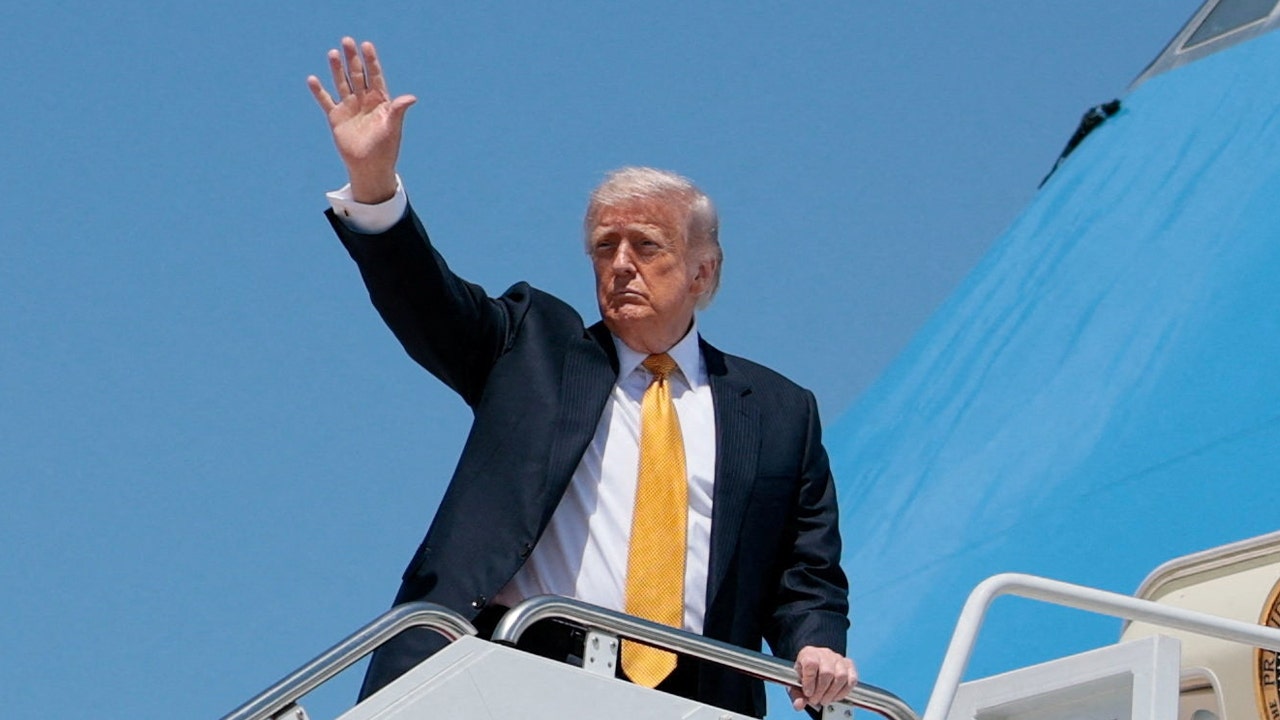
Air Force One landed in Beijing on the evening of May 13, 2026. Chinese Vice President Han Zheng and a senior Foreign Ministry delegation met Trump on the tarmac, and Trump was driven into the capital ahead of a formal welcome ceremony the next morning. The trip was Trump's first to China since November 2017 and the first state visit by a sitting U.S. president to China in nearly nine years.
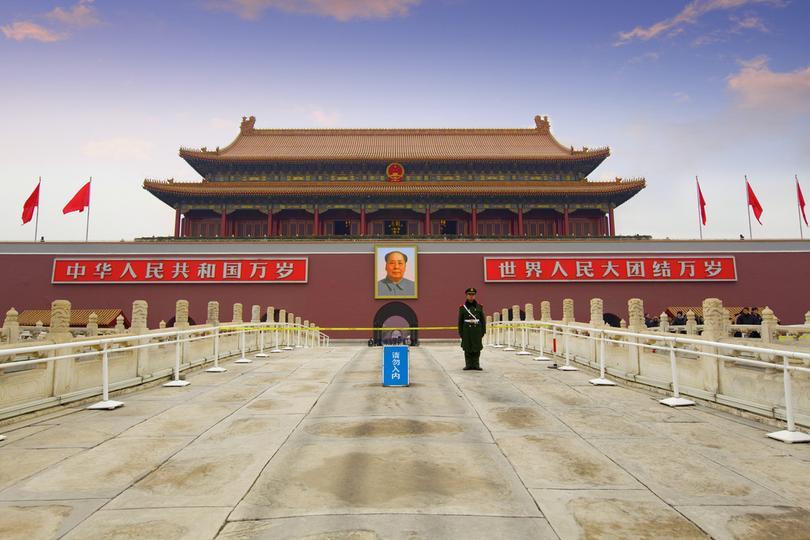
On the morning of May 14, Trump received a full state arrival ceremony outside the Great Hall of the People on Tiananmen Square: a cannon salute, a Chinese military honor guard, both national anthems, and schoolchildren waving flowers and U.S. and Chinese flags. "That was an honor like few I have ever seen before," Trump told reporters afterward. He and Xi then shook hands on the red carpet and moved inside for a closed-door bilateral that ran roughly two hours and 15 minutes, longer than scheduled.
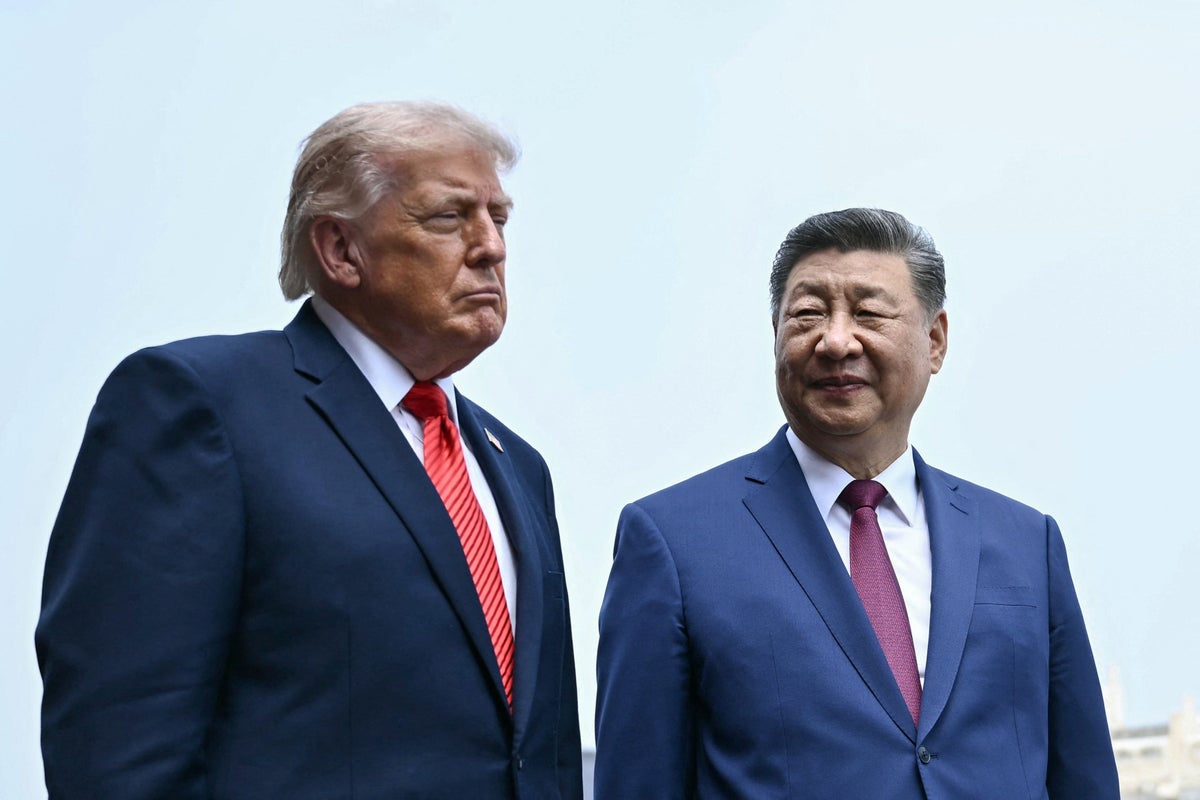
Trump opened the meeting by calling Xi a "great leader" and "friend," saying "it's an honour to be your friend" and that "whenever we had a problem we worked it out very quickly." Xi responded that the United States and China should be "partners, not rivals" and that bilateral ties had remained "generally stable" through their meetings and phone calls. Xi also invoked the "Thucydides Trap" — the historical pattern of war between rising and incumbent powers — and asked whether the two countries could chart a new course.
After the bilateral, Trump and Xi toured the Temple of Heaven, the 15th-century Ming and Qing imperial complex. A brief standoff occurred at the site when Chinese security blocked a U.S. Secret Service agent from entering, delaying the tour by more than half an hour, according to NBC News. That evening Xi hosted a state banquet at the Great Hall of the People attended by Trump, members of his cabinet and the visiting U.S. CEOs. At the banquet Trump said the two leaders had held "extremely positive and productive discussions" and Xi told guests that "the great rejuvenation of the Chinese nation and making America great again can go hand in hand." Trump publicly invited Xi to visit the White House on September 24, 2026.
The two delegations met again on the morning of May 15 before Trump departed Beijing.
The deals
- China to order 200 Boeing jets — well below the 500 Wall Street had penciled in. Boeing fell more than 4% on the day.
- Trade truce extended; Xi told CEOs China will "open wider" to U.S. business.
- Reuters reported U.S. approval of Nvidia H200 chip sales to some Chinese firms on May 14; Treasury called it news to them.
The headline commercial announcement was a Chinese order for 200 Boeing jets. Trump disclosed the figure in a Fox News interview after the bilateral, saying Boeing had wanted 150 but secured 200 — "200 big ones" — without specifying models. Wall Street had been pricing in a much larger order; Jefferies and Wolfe Research had flagged the possibility of up to 500 aircraft. Boeing stock fell more than 4% on May 14, its steepest one-day drop in six months. It is still Boeing's first major Chinese order in close to a decade; China has bought primarily from Airbus since 2017.
The two sides also signaled an extension of the trade truce Trump and Xi reached at their October 2025 meeting in Busan, South Korea. That truce had paused the tit-for-tat tariff exchanges that began when Trump imposed 20% tariffs on Chinese goods in February 2025 over fentanyl, and was scheduled to expire this fall. Kalshi prediction-market traders had priced an 86% probability that Trump would announce both the Boeing order and a truce extension, according to CNBC.
A White House readout said the two sides discussed expanded Chinese purchases of U.S. agricultural products — soybeans, beef and grain — and broader market access for American firms in China. Xi told the visiting CEOs that China's door to U.S. business will "open wider," according to Xinhua. Reuters reported the same day that Washington had approved Nvidia's sale of its H200 chips to certain Chinese tech firms; Treasury Secretary Scott Bessent told CNBC the approval was news to him and referred questions to Commerce. Nvidia shares rose more than 4% on May 14 after that report, following a 2.3% gain the prior day when Huang's last-minute addition to the trip was confirmed.
Fentanyl, which Trump cited as the basis for the original 2025 tariffs, was on the agenda; no specific enforcement announcement was published in the readouts. Trump asked U.S. officials to finalize details of a U.S.-China "board of trade" during the visit, according to Bloomberg.
Iran and the Strait of Hormuz
- Joint readout: Hormuz "must remain open" and Iran can never have a nuclear weapon.
- Bessent said China has a "much bigger interest" in reopening the strait and will work behind the scenes with Tehran.
- Rubio said the U.S. was not formally asking China for help on Iran; Trump had said before departure he had "no need" for it.
The Strait of Hormuz dominated the strategic portion of the summit. Iran has blockaded the strait since early March in response to U.S. and Israeli strikes that killed senior Iranian leaders, including head of state Ayatollah Ali Khamenei. The closure has cut off about a fifth of global crude and LNG flows and contributed to U.S. inflation running at 3.8% in April, the highest since 2023.
In the joint readout, Washington and Beijing agreed the strait "must remain open" and that Iran can never have a nuclear weapon. Xi told Trump China opposes militarization of the strait and any toll regime on its use, and expressed interest in buying more U.S. oil — including Alaskan crude — to diversify away from Hormuz flows. Treasury Secretary Scott Bessent told CNBC that "China has a much bigger interest in reopening the strait than the U.S. does" and that Beijing would work "behind the scenes" with Tehran. China is the world's largest crude importer and the destination for nearly all of Iran's oil exports.
Secretary of State Marco Rubio — who flew to Beijing despite 2020 Chinese sanctions over his criticism of Beijing's Xinjiang and Hong Kong policies (Chinese authorities used a transliterated version of his name to allow entry) — told NBC News that Trump raised the war and asked Beijing to press Tehran to "back down on its actions in the Gulf." Rubio also said the U.S. was not formally requesting Chinese help. Trump had said before departure that he had "no need" for Xi's help on Iran. Iran's National Security Council spokesperson responded that new confrontations with the U.S. remain possible and that Tehran is preparing a domestic law on navigation through the strait.
U.S. officials separately alleged before the trip that Chinese firms had discussed routing weapons sales to Iran through third countries, and that China had supplied Iran with intelligence, satellite support and dual-use technology during the conflict while continuing to buy discounted Iranian oil. Trump did not publicly say whether he raised those allegations with Xi.
The Taiwan warning
- Xi: mishandling Taiwan could mean "clashes and even conflicts" and "a very dangerous situation."
- White House readout omitted Taiwan; Chinese readout led with it. Rubio said arms-sale policy is not expected to change.
- KMT dropped its block on Taiwan's defense budget on the eve of the summit.
Xi delivered the summit's sharpest public message on Taiwan. According to Chinese state-media readouts carried by Xinhua, Xi told Trump that mishandling Taiwan would produce "clashes and even conflicts, putting the entire relationship in great jeopardy." He called Taiwan "the core of China's core interests" and the "bedrock of the political foundation of China-U.S. relations," and said Taiwan independence and peace across the Taiwan Strait are incompatible. Foreign Ministry spokesperson Mao Ning reiterated the formulation publicly.
The two governments offered very different accounts of what was discussed. The White House readout did not mention Taiwan at all, focusing on Iran, Hormuz and trade. Trump declined to say whether Taiwan came up. Rubio told NBC News separately that arms sales to Taiwan were not a major focus of the current talks and that the administration's Taiwan policy was not expected to change. He also acknowledged Chinese military pressure on Taiwan has increased, and pointed to the March 2026 U.S. intelligence community annual assessment stating there is no Chinese invasion of Taiwan planned for 2027.
The Senate had moved before the summit to reaffirm the Taiwan Relations Act, and a bipartisan group of senators led by Steve Daines had urged the administration to release a delayed Taiwan arms package that had been held by the State Department in the run-up to the meeting. In Taipei, Taiwan's government said it expected "no surprises" from the summit and urged Beijing to end its military pressure on the island. Taiwan staged a live-fire drill on an offshore island facing the mainland as Trump's plane crossed the Pacific.
The domestic Taiwanese politics also moved. The opposition Kuomintang dropped its blockade of Taiwan's defense budget on the eve of the summit; the South China Morning Post asked whether U.S. pressure ahead of the Trump-Xi meeting had forced the KMT's hand. Separately, KMT Vice Chair Chang Rong-kung met China's top Taiwan-affairs official Wang Huning at the Cross-Strait Chinese Culture Summit in Beijing on May 11, telling him relations were "not state-to-state."
The CEO delegation
- 18-strong CEO delegation: Musk, Cook, Huang, Fink, Ortberg, Fraser, Solomon, Schwarzman, Culp, Sikes, Mehrotra, Amon and others.
- Huang was initially off the list, then added; he called the summit "one of the most important summits in human history."
- Musk traveled while under a recall warning from the judge in his OpenAI trial.
Trump traveled with one of the largest American corporate delegations to accompany a sitting president to China. The initial 17-CEO list reported by CNBC, NYT and BBC included Elon Musk (Tesla, SpaceX, X), Tim Cook (Apple), Larry Fink (BlackRock), Jane Fraser (Citigroup), Kelly Ortberg (Boeing), Ryan McInerney (Visa), Michael Miebach (Mastercard), Sanjay Mehrotra (Micron), Cristiano Amon (Qualcomm), Larry Culp (GE Aerospace), Brian Sikes (Cargill), Dina Powell McCormick (Meta), David Solomon (Goldman Sachs), Stephen Schwarzman (Blackstone), Jacob Thaysen (Illumina) and Jim Anderson (Coherent). Cisco's Chuck Robbins withdrew citing earnings.
Nvidia CEO Jensen Huang was initially excluded — a snub widely read as related to U.S. export-control politics. Trump reversed course mid-flight, posting that Huang was aboard Air Force One after a stopover in Alaska. Nvidia shares rose 2.3% on the news. Huang told reporters that the summit was "one of the most important summits in human history."
Musk's presence was notable for two reasons. First, his trip came during the closing days of his OpenAI trial in Oakland, California; U.S. District Judge Yvonne Gonzalez Rogers had warned that he could be "recalled" to the witness stand. A Vanderbilt law professor told NBC News that "a typical witness would not leave the country if they were subject to recall." Second, Musk and Trump had publicly fallen out a year earlier after Musk's stint downsizing the federal government; the two have since reconciled. Musk was photographed taking selfies with Chinese business leaders during the trip and told reporters he had "a good feeling about these talks."
At a meeting at the Great Hall of the People, Trump introduced each executive to Xi individually. Xi told the group, whose combined net worth exceeds $1 trillion, that China would "open wider" to U.S. business and that American firms had "benefited" from China's reform. The White House said the two sides discussed expanded market access for U.S. companies and increased Chinese investment in the United States.
The symbolism
- Full state arrival ceremony — cannon salute, honor guard, children with flags; Temple of Heaven tour after the bilateral.
- Banquet quotes: Trump's "extremely positive"; Xi's "rejuvenation of China and Make America Great Again can go hand in hand."
- Melania Trump did not travel; Vice President Han Zheng met Trump at the airport on May 13.
Beijing put on a production. The May 14 arrival ceremony at the Great Hall of the People featured a Chinese military honor guard, a cannon salute, marching troops, military bands playing both anthems, and hundreds of children waving flags and bouquets along the red carpet — staging Fox News and others compared to Trump's 2017 "state visit-plus." Trump praised the welcome as "an honor like few I have ever seen before" and called the children "happy" and "beautiful."
The Temple of Heaven tour after the bilateral was carefully chosen. The 15th-century complex was where Ming and Qing emperors prayed for good harvests; the Financial Times had previewed the venue as a setting calibrated to project Chinese civilizational continuity. Trump called the site "a great place, incredible" and posed for photographs with Xi. The half-hour standoff between Chinese security and a U.S. Secret Service agent at the entrance, reported by NBC News, was the only visible friction of the day.
The state banquet that evening produced the summit's most-quoted lines. Trump: "We had extremely positive and constructive discussions." Xi: "Rejuvenation of the Chinese nation and Make America Great Again can go hand in hand." The BBC noted Xi described the U.S.-China relationship as the world's "most important," representing a combined population of 1.7 billion people. Trump publicly invited Xi and his wife Peng Liyuan to visit the White House on September 24, 2026.
First Lady Melania Trump did not accompany the president — a deliberate contrast with the 2017 visit, when she had toured the Banchang Primary School with Peng Liyuan, visited the Great Wall and the Beijing Zoo, and joined an elaborate cultural program. The Office of the First Lady confirmed the absence in advance. The optics were softened by Vice President Han Zheng's airport reception on May 13.
What was not discussed publicly
- No public mention in the readouts of Uyghurs, Hong Kong or Jimmy Lai.
- Pastor Ezra Jin Mingri's family appealed publicly for the summit to address detained Americans and religious prisoners; no commitment was announced.
- Pre-trip U.S. allegations of Chinese arms support to Iran did not appear in either readout.
Several long-running U.S.-China irritants were absent from the public summit agenda. Neither readout mentioned Xinjiang or the Uyghurs — though Rubio's 2020 sanction by Beijing for his criticism of Beijing's Xinjiang record was the reason China had to use a transliterated version of his name to admit him. Hong Kong, including the Jimmy Lai trial, did not feature in any public statement.
Detained Americans and political prisoners were a pre-summit issue without a public outcome. The Hudson Institute had urged the administration to bring home Chinese political prisoners. The daughter of Pastor Ezra Jin Mingri, founder of the Zion Church house-church network in China, wrote in a Fox News op-ed asking Trump to push for her father's release; Pastor Jin and roughly 30 other Zion Church leaders were detained in October 2025 in what observers called the most extensive Chinese religious crackdown in decades, with 18 formally arrested. No public commitments on detained Americans or imprisoned pastors were announced from the summit.
Allegations of Chinese support to Iran during the war — secret arms-sale discussions routed through third countries, intelligence and satellite support, and continued purchases of discounted Iranian crude — surfaced in U.S. media before the trip but did not appear in either side's readout. The White House also did not publicly press the fentanyl precursor issue at the summit despite Trump anti-terrorism chief Sebastian Gorka's pre-trip accusation that China had engaged in the "targeted killing of Americans" with fentanyl.
Market and economic reaction
- U.S. 30-year bond cleared at a 5% yield during summit week — first time since 2007.
- Boeing posted its biggest single-day fall in six months on a 200-jet order vs. the 500 Wall Street penciled in; Nvidia rose on H200 export reports.
- April U.S. CPI hit 3.8% — highest since 2023 — driven by Hormuz-related energy prices; Iran war cost ~$29 billion through May 12.
The summit landed in an unsettled market. The U.S. Treasury sold 30-year bonds at a 5% yield during summit week — the first time the long bond cleared at 5% since 2007 — as fiscal and inflation pressures from the Iran war weighed on the long end. Trump-era allies and incoming Fed Chair Kevin Warsh, confirmed 54-45 by the Senate the same week in the closest Fed-chair vote on record, have publicly warned against rate cuts pending inflation data.
U.S. consumer prices rose 3.8% year-over-year in April, the highest reading since 2023, driven primarily by energy. Producer prices climbed sharply the same month, suggesting the Hormuz-driven energy shock is spreading. The Pentagon said the Iran war has cost nearly $29 billion through May 12. Brent crude traded near $105 a barrel on Trump's departure day, gasoline was up more than a dollar a gallon year-over-year, and Saudi Aramco's CEO told analysts the strait closure was losing global oil markets 100 million barrels a week.
Equities went the other way on summit hopes. The S&P 500 and Nasdaq rose on May 13 ahead of the meeting, led by AI tech. Nvidia jumped on Huang's addition to the delegation and again on the Reuters report of H200 export approvals to China. Boeing went the opposite direction on May 14 — its biggest single-day drop in six months — when the announced order came in at 200 jets instead of the 500 Wall Street had hoped for.
In commodities, bitcoin held just below $81,000 ahead of the Trump-Xi meeting, according to CoinDesk. The copper-to-gold ratio crossed above its 200-day moving average for the first time meaningfully since September 2020. Chinese export data the prior week showed a 14.1% year-over-year jump in April, beating consensus and underscoring the resilience of the trade flows the two leaders were ostensibly meeting to manage.
What comes next
- September 24, 2026 Xi visit to Washington set; trade-truce extension and Boeing order announced.
- Open questions: Taiwan readout gap, scale of Boeing order, whether Beijing actually moves Tehran on Hormuz.
- Competing post-summit takes: stabilization vs. weakened-Trump-accepts-atmospherics.
The visible deliverables fit a stabilization frame rather than a breakthrough. Trump and Xi each described the relationship as stable and important. A trade truce extension and a 200-jet Boeing order were announced; a U.S.-China "board of trade" architecture was requested by Trump; Beijing signaled a behind-the-scenes nudge to Tehran on Hormuz; and a September 24, 2026 reciprocal Xi visit to the White House was set.
The gaps were equally visible. The two readouts disagreed on whether Taiwan was discussed at all. The Boeing order disappointed market expectations. The Iran outcome remains contingent on Tehran. Rubio told NBC the U.S. was not formally asking for Chinese help on Iran even as the joint readout committed both sides to keeping Hormuz open. And Beijing's pre-summit alleged support to Iran — and Washington's pre-summit sanctions on Chinese firms aiding the Islamic Revolutionary Guard Corps — went unmentioned in the public deliverables.
Two competing post-summit theses dominated commentary. One held that the meeting represented a stabilization of the world's most consequential bilateral after a year of tariff brinksmanship and an Iran war that had complicated U.S. leverage. The other, advanced by Le Monde, Foreign Policy and the Atlantic Council, held that an inflation- and war-weakened Trump had walked into Beijing from a position of reduced leverage and accepted limited deliverables in exchange for atmospherics. Both will be tested in the run-up to the September White House visit, the fall trade-truce expiration date, and the next round of Hormuz developments.