Artemis II Astronauts Share Experiences from Historic Lunar Flyby Mission
The four Artemis II astronauts held a press conference to discuss their 10-day mission around the moon, highlighting views of the lunar far side and a solar eclipse. They described emotional moments and the spacecraft's performance during reentry. The mission tested NASA's Orion capsule and Space Launch System rocket for future lunar landings.
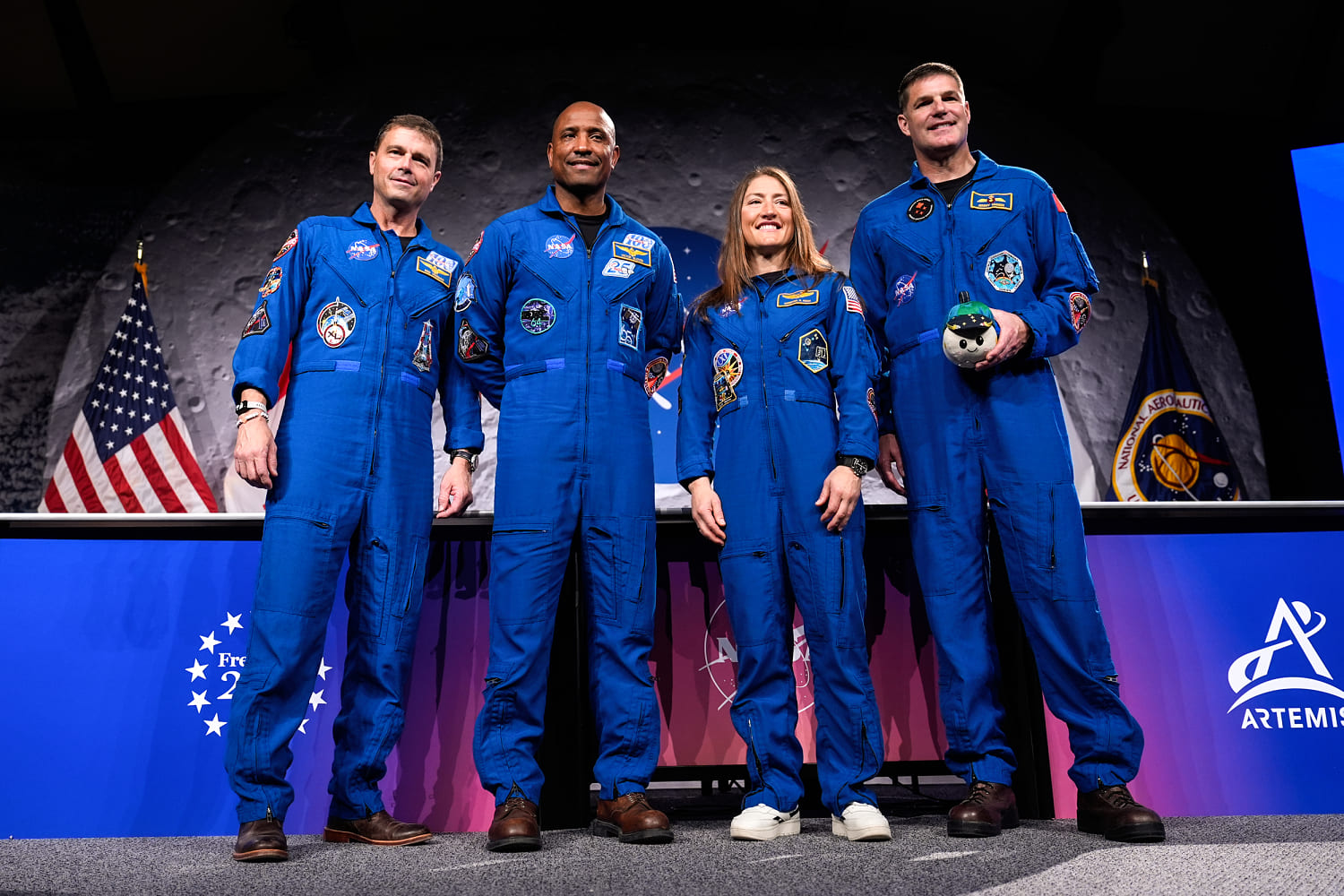
Nbc NewsThe Artemis II crew, consisting of NASA astronauts Reid Wiseman, Victor Glover, Christina Koch, and Canadian astronaut Jeremy Hansen, spoke at a press conference on Thursday at NASA's Johnson Space Center in Houston. They described their experiences from the mission, which launched on April 1 from Kennedy Space Center in Florida and concluded with a splashdown on April 10 in the Pacific Ocean off San Diego.
The flight marked the first crewed test of the Orion spacecraft and Space Launch System rocket.
The astronauts traveled farther from Earth than any previous humans, reaching a distance of 252,756 miles. They flew around the far side of the moon on April 6, observing terrain not visible from Earth and witnessing a solar eclipse lasting nearly an hour. The mission covered a total distance of nearly 700,000 miles.
Mission Highlights and Crew Observations
During the flyby, the crew photographed the moon's cratered landscape and experienced a three-dimensional view of stars, the moon, and Earth.
Hansen noted the depth perception of the galaxy, describing it as mind-blowing. The solar eclipse produced a ghostly glow around the lunar horizon, which Wiseman called otherworldly. >"When the sun eclipsed behind the moon, I turned to Victor and I said I don't think humanity has evolved to the point of being able to comprehend what we're looking at right now.
" — Reid Wiseman, Thursday (CBS News) The crew proposed naming two lunar craters: one Integrity, after their spacecraft, and the other Carroll, in honor of Wiseman's late wife who died of cancer in 2020. This dedication was planned by Glover, Koch, and Hansen before launch.
Reentry and Post-Mission Adjustments
Upon reentry, the Orion capsule entered Earth's atmosphere at over 24,000 mph, with the crew observing a fireball outside the spacecraft.
Wiseman reported a smooth ride despite minor char loss from the heat shield, which showed no major damage upon initial inspection. NASA officials stated the reentry trajectory differed from a 2022 unpiloted test to address prior heat shield issues. After splashdown, the astronauts underwent medical evaluations aboard a Navy recovery ship.

Wiseman requested a visit from the ship's chaplain, leading to an emotional moment despite not being religious. The crew flew back to Houston on April 11, landing at Ellington Field to greetings from family and colleagues. >"I just screamed.
I was so happy. " — Christina Koch, Thursday (NBC News) The astronauts have not fully processed the experience due to ongoing medical testing and debriefs. They reported initial disorientation, such as feeling like they were floating upon waking.
The mission aimed to test systems for future lunar landings and unite global audiences, with the crew noting widespread public support.
Background and Future Implications Artemis
II was NASA's first piloted lunar mission since Apollo 17 in 1972.
The free-return trajectory used lunar gravity to loop the spacecraft back to Earth without major engine firings. The crew tested life support, navigation, and propulsion during an initial elliptical Earth orbit. The mission set records, surpassing the Apollo 13 distance mark from 1970.
While out of contact behind the moon for 40 minutes, the astronauts viewed previously unseen lunar areas. NASA plans to inspect the heat shield fully at Kennedy Space Center. Hansen became the first Canadian beyond low-Earth orbit.
The crew emphasized feelings of human unity and smallness in the universe. They launched as friends and returned as best friends, according to Wiseman.
Story Timeline
6 events- Apr 17, 9:03 AM ET
3 new sources added: CBS News, @NBCNews, ABC News
3 sourcesCBS News · @NBCNews · ABC News - Apr 17, 8:02 AM ET
3 new sources added: The Bbc, @BBCBreaking, BBC News
3 sourcesThe Bbc · @BBCBreaking · BBC News - Apr 17, 2026
Artemis II crew held a press conference at Johnson Space Center, sharing mission experiences.
8 sourcesCBS News · NBC News · BBC - Apr 10, 2026
Orion capsule splashed down in the Pacific Ocean off San Diego after reentry.
4 sourcesCBS News · NBC News · GB News - Apr 6, 2026
Crew flew around the moon's far side, observed solar eclipse, and set distance record.
5 sourcesCBS News · NBC News · BBC - Apr 1, 2026
Artemis II launched from Kennedy Space Center aboard SLS rocket and Orion capsule.
3 sourcesCBS News · BBC · NBC News
Potential Impact
- 01
NASA will analyze heat shield performance to refine designs for Artemis III lunar landing.
- 02
Photographs and data from far side will aid scientific mapping of lunar terrain.
- 03
Global interest in space exploration will increase support for future Artemis missions.
- 04
Crew insights will improve training protocols for deep space psychological effects.
- 05
International collaboration will strengthen with Canada's role highlighted.
- 06
Mission success will accelerate timelines for establishing permanent lunar presence.
Transparency Panel
Related Stories
The War ZoneU.S. Military Outlines Blockade Efforts Against Iranian-Linked Ships Amid Cease-Fire
U.S. military officials detailed ongoing naval blockade operations targeting Iranian-linked vessels globally, emphasizing warship capabilities and allied partnerships. Statements highlighted the degraded state of Iranian command and control, with warnings against cease-fire viola…
NASA Johnson Space Center / Wikimedia (Public domain)NASA's Artemis II Completes First Manned Moon Mission Since 1972, Sets Distance Record
NASA's Artemis II mission completed a flight around the moon and splashed down in the Pacific Ocean on Saturday. The mission marks the first manned moon mission since 1972 and set a record for the furthest humans have travelled into space at 252,756 miles (406,771km). Meanwhile,…
theprint.inRevolution Medicines Reports Extended Survival in Pancreatic Cancer Trial
Revolution Medicines announced results from a Phase 3 study of its experimental drug daraxonrasib for advanced pancreatic adenocarcinoma. Patients treated with the drug had a median survival of 13.2 months, compared to 6.7 months for those on standard chemotherapy. The company pl…