science
CRISPR Base Editing Study Shows NANOG Gene Is Required for Human Embryo Cell Formation
Researchers disabled the NANOG gene in fertilized human eggs using CRISPR base editing and found that none of the cells developed into those forming the embryo proper. The study, published in Nature, also compared results in mouse eggs and noted reduced mosaicism rates.
 neurosciencenews.com
Audio version
Tap play to generate a narrated version.
Developing·Limited corroboration so far. This page will refresh as more sources emerge.
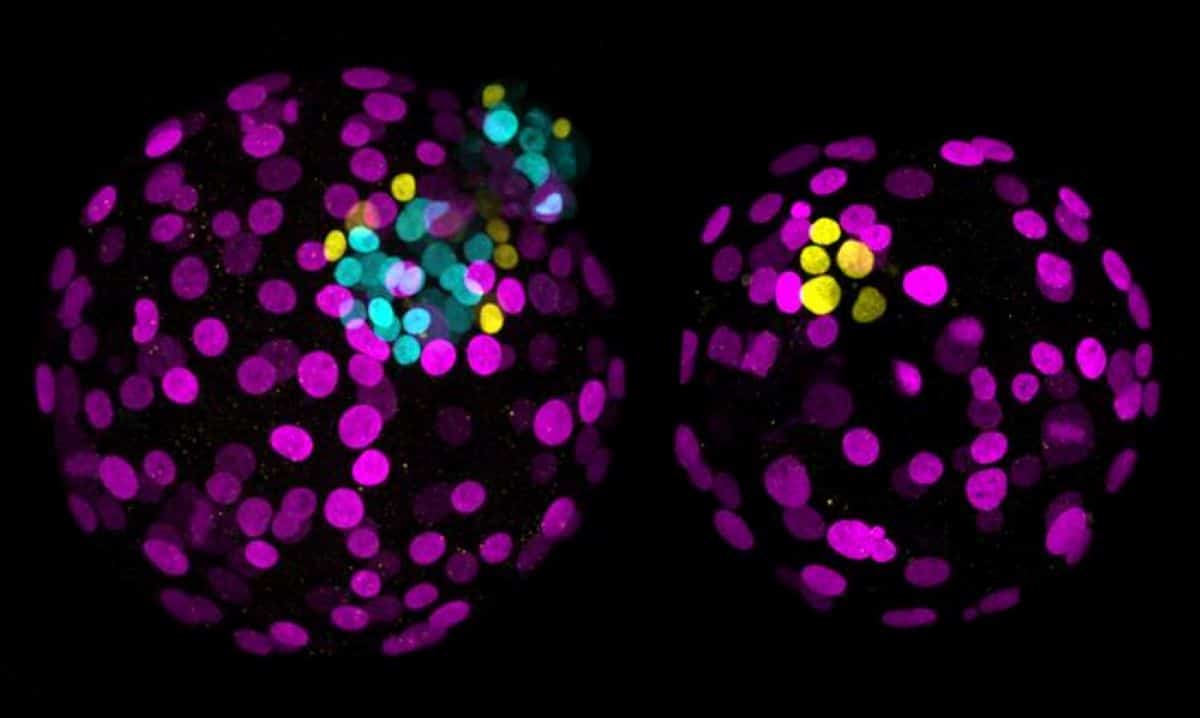
Researchers disabled the NANOG gene in fertilized human eggs donated by women undergoing IVF and found that none of the resulting cells developed into those that form the embryo proper. The activation of NANOG therefore initiates the developmental program that produces cells forming a human body, Kathy Niakan at the University of Cambridge said.
The team performed the edits with CRISPR base editing, a method that alters a single DNA letter at a time rather than cutting DNA strands.
They injected the gene-editing machinery into eggs along with sperm, an approach that lowered the rate of mosaicism to 50 percent of eggs still showing mixed edited and unedited cells. In parallel experiments with mouse eggs, disabling NANOG prevented cells from becoming yolk sac progenitors, revealing a species-specific role for the gene.
Niakan’s study is the first to apply CRISPR base editing specifically to investigate gene function in human embryos, she stated.
The work was published in Nature with the DOI 10.1038/s41586-026-10792-1. An earlier preprint by Dieter Egli at Columbia University described base editing in two-cell human embryos and focused on correcting disease-associated mutations, with one attempted edit producing mosaicism in 80 percent of embryos.
Mary Herbert at Monash University, part of Niakan’s team, said the technology is not ready for creating gene-edited children.
Robin Lovell-Badge at the Francis Crick Institute added that a 50 percent mosaicism rate would still be too high for correcting disease-causing DNA variants. Niakan noted that one out of two embryos that appear normal in shape under a microscope lack the potential to implant. Identifying markers such as NANOG could therefore help improve IVF success rates, she said.