Fossil Study Identifies Giant Scorpion Species From Early Devonian Wales
Researchers identified a metre-long scorpion from fossils in Wales that lived about 415 million years ago. The specimen had been held in museum collections for over 150 years and was previously classified as a crustacean.
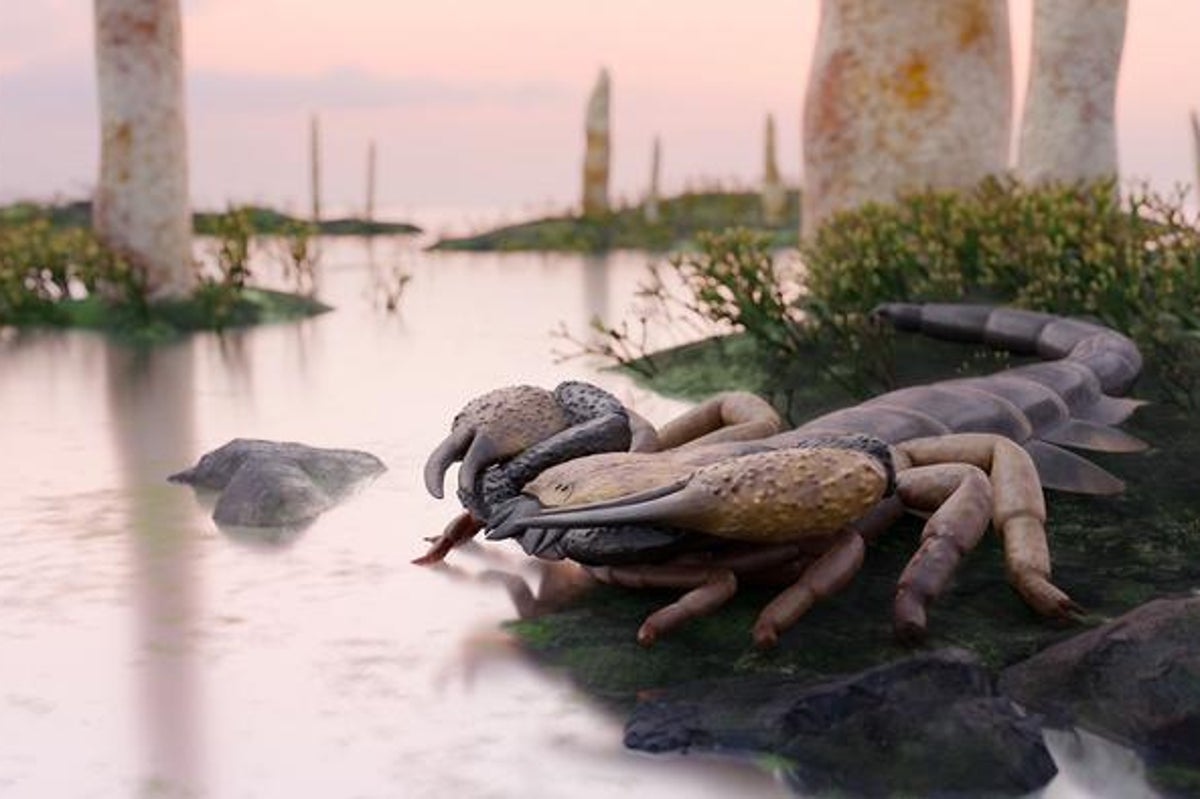 The Independent
A fossil study has identified a metre-long scorpion species with pincers exceeding 16 centimetres that lived on the floodplains of what is now England and Wales. The species, named Praearcturus gigas, is described as the largest scorpion of its kind on record.
The animal existed during the Early Devonian period, roughly 415 million years ago, when small plants and fungi had begun to appear on land but trees and complex forests had not yet evolved. Researchers examined a specimen from the St Maughan’s sandstone formation in Wales that had been stored at the Natural History Museum for more than 150 years.
For over a century the fragmentary fossils were thought to belong to a giant crustacean similar to a woodlouse because key features such as a tail were missing. Recent discoveries of better-preserved specimens and advanced imaging techniques allowed researchers to determine the fossils represent a distinct scorpion species.
“Confirming that this animal is a scorpion fundamentally changes our understanding of how and when these creatures evolved to such extraordinary sizes,” said the lead author of the study published in the journal Palaeontology.
The scorpion lived when most terrestrial life remained small. Researchers suggest it may have spent part of its life in water, aided by flap-like abdominal structures similar to those in modern crustaceans such as lobsters. “The boundary between land and sea was much less defined at this time,” said a study co-author from the Natural History Museum.
Specimens collected more than a century ago continue to yield new information when examined with current analytical methods.
Transparency
Story details
Related Stories
 France 24
Marjane Satrapi, Author of 'Persepolis,' Dies at 56 a Year After Husband
The French-Iranian graphic novelist died Thursday in a statement from people close to her. She had refused France's highest civilian honor last year over its Iran policy.
 spacenews.com
NASA Loses Contact with MAVEN Mars Orbiter, Begins Decommissioning After Battery-Draining Anomaly
The agency announced Wednesday that the MAVEN orbiter is unrecoverable following an anomaly that drained its batteries. The mission produced more than 800 publications on Mars’ atmosphere over twelve years.