IEA Report: Methane Emissions Plateau Near Record Highs in 2025; Strait of Hormuz Disruptions
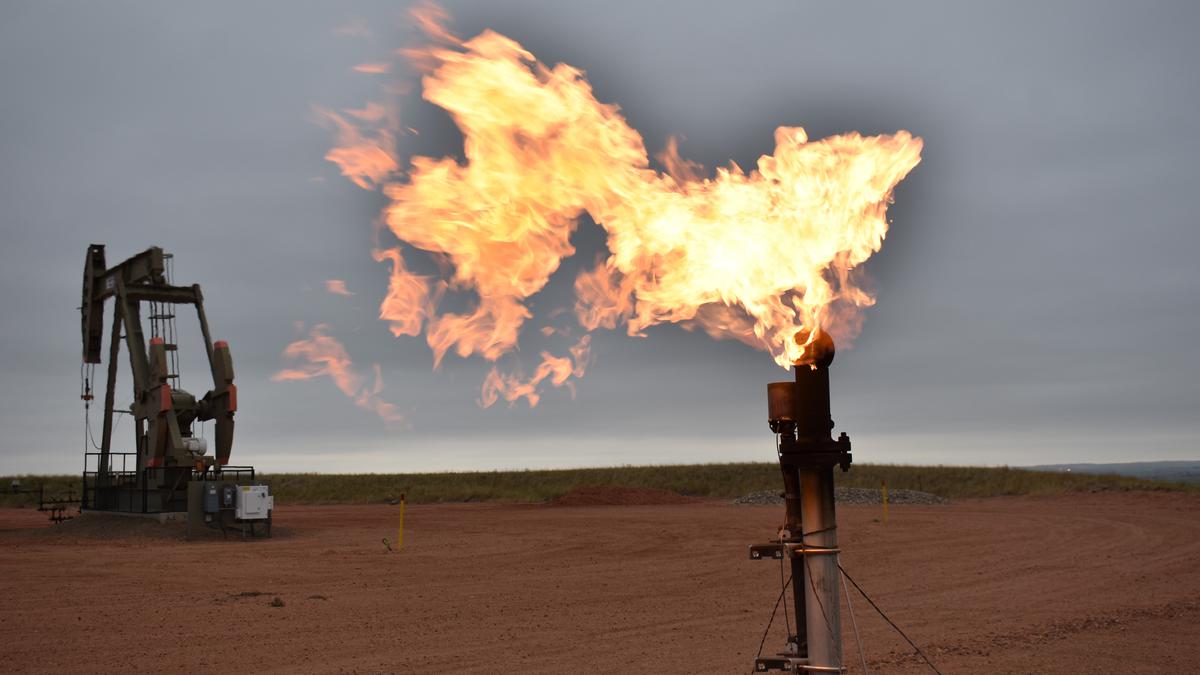
The International Energy Agency reported that methane emissions from the energy sector plateaued at near record highs in 2025. Abatement measures could make up to 200 billion cubic metres of natural gas available annually, potentially doubling volumes trapped by the Strait of Hormuz closure. Satellite data highlighted mega-leaks in countries including Turkmenistan, the U.S., Venezuela, and Iran.
thehindu.comMethane emissions from the energy sector remained at near record levels in 2025, according to the International Energy Agency's Global Methane Tracker 2026 report released on Monday. The report, based on data from satellites and measurement campaigns, presents emissions findings for 2025 and explores abatement measures.
Tackling these emissions has become a priority as the war in the Middle East squeezes energy supplies.
Tried-and-tested abatement measures could make 200 billion cubic metres of natural gas available annually from energy sector methane emissions, the IEA stated. If select countries with spare gas export capacity and importing countries implemented readily accessible methane abatement measures across their gas systems, nearly 15 billion cubic metres of gas could very quickly be made available to markets.
Longer-term methane abatement measures could deliver nearly 100 billion cubic metres of gas to markets each year, while eliminating non-emergency gas flaring could unlock a further 100 billion cubic metres.
Global methane abatement measures could unlock natural gas volumes double the current supply trapped by the effective closure of the Strait of Hormuz in the longer term, the IEA said. The near-closure of the Strait of Hormuz has removed almost 20% of global liquefied natural gas supply from the market, cutting off exports from Qatar and the United Arab Emirates.
Separately, Qatar's LNG capacity has been severely damaged by Iranian missile attacks, forcing QatarEnergy to declare force majeure on contracts and quantify losses.
Satellite analysis by the Stop Methane Project at the University of California, Los Angeles found mega-leaks of methane occurring around the world in 2025. The top 25 list of methane mega-leaks in 2025 was dominated by facilities in Turkmenistan. 5 tonnes of methane per hour, equivalent to emissions from running about one million fuel-guzzling four-wheel drives.
Multiple methane mega-leaks occurred from state-owned facilities in Venezuela in 2025, according to the Stop Methane Project at UCLA. The Stop Methane Project analyzed super-polluting methane plumes from landfill sites in 2025, with the worst sites located in Turkey, Algeria, Malaysia, and the US.
Turkmen officials claimed in October 2025 that methane mega-leaks had been reduced. “Management has placed this under special control, and leaks are being repaired locally within two to three days,” said Muhammetberdi Byashiev, the head of the environmental protection department at the state company Türkmengaz.
Byashiev cited collaboration with the UN, IEA, and EU in addressing methane leaks in October 2025.
Analysis showed that substantial methane mega-leaks continued in Turkmenistan after October 2025, according to the Stop Methane Project at UCLA.
Key Facts
Story Timeline
6 events- 2026-05-04
International Energy Agency releases Global Methane Tracker 2026 report on 2025 emissions.
3 sourcesInternational Energy Agency · The Guardian · OilPrice.com - 2025-10
Turkmen officials claim methane mega-leaks reduced, with statement from Muhammetberdi Byashiev.
2 sourcesTurkmen officials · The Guardian - 2025
Methane emissions from energy sector remain at near record levels; mega-leaks detected worldwide.
3 sourcesInternational Energy Agency · Stop Methane Project at UCLA · The Guardian - 2025
Largest methane mega-leak in Texas, USA, at 5.5 tonnes per hour.
1 sourceStop Methane Project at UCLA - 2025
Qatar's LNG capacity damaged by Iranian missile attacks, leading to force majeure.
1 sourceOilPrice.com - Recent (2026 context)
Effective closure of Strait of Hormuz traps gas supplies from Qatar and UAE.
2 sourcesInternational Energy Agency · OilPrice.com
Potential Impact
- 01
Continued energy market tightness due to Hormuz closure and Qatar damage.
- 02
Long-term addition of 100 billion cubic metres of gas from abatement and flaring elimination.
- 03
Challenges in Turkmenistan despite claimed repairs, affecting regional emission controls.
- 04
Improved global gas supply security through quick abatement in select countries.
- 05
Potential reduction in greenhouse gas emissions if leaks are addressed.
Transparency Panel
Related Stories
Oil Prices Drop After Reports of U.S.-Iran Talks on Ending War and Reopening Strait of Hormuz
Oil prices dropped significantly following reports that the U.S. and Iran are close to a memorandum of understanding to halt fighting and begin nuclear talks. President Trump announced a pause in the U.S. naval escort operation in the Strait of Hormuz. Iran is expected to respond…
FDA Withdraws Studies Supporting Safety of COVID and Shingles Vaccines
The U.S. Food and Drug Administration blocked the publication of research finding rare side effects from COVID and shingles vaccines. The studies were withdrawn due to broad conclusions not supported by data, amid broader efforts by the Trump administration to challenge vaccine r…
UAE Leaves OPEC After 60 Years of Membership, Reducing Group to 11 Producers
The United Arab Emirates departed the Organization of the Petroleum Exporting Countries on Tuesday, reducing the group's membership to 11 nations. OPEC members now account for about 33% of global crude oil output. The exit occurs amid high oil prices and the ongoing closure of th…