Unbiased AI-powered news
An Associated Press journalist spent a month in the epicenter of an Ebola outbreak in eastern Congo, documenting the toll on residents and the challenges facing health workers amid ongoing conflict.
The IndependentMourners stood at a distance as a small coffin was lowered into the grave. Health workers wearing masks and gloves joined a priest who prayed. A 6-month-old girl was the latest victim of the outbreak. She was the third child in her orphanage to die.
From afar, the epidemic is often measured in numbers: over 1,300 confirmed cases, hundreds of deaths, tens of thousands of people who may have had contact with them. The funeral is when we truly realized the gravity of the outbreak. Ebola does not distinguish between young and old, educated and uneducated, rich and the poor, civilians and health professionals.
Reporting on this outbreak means multiple dangers.
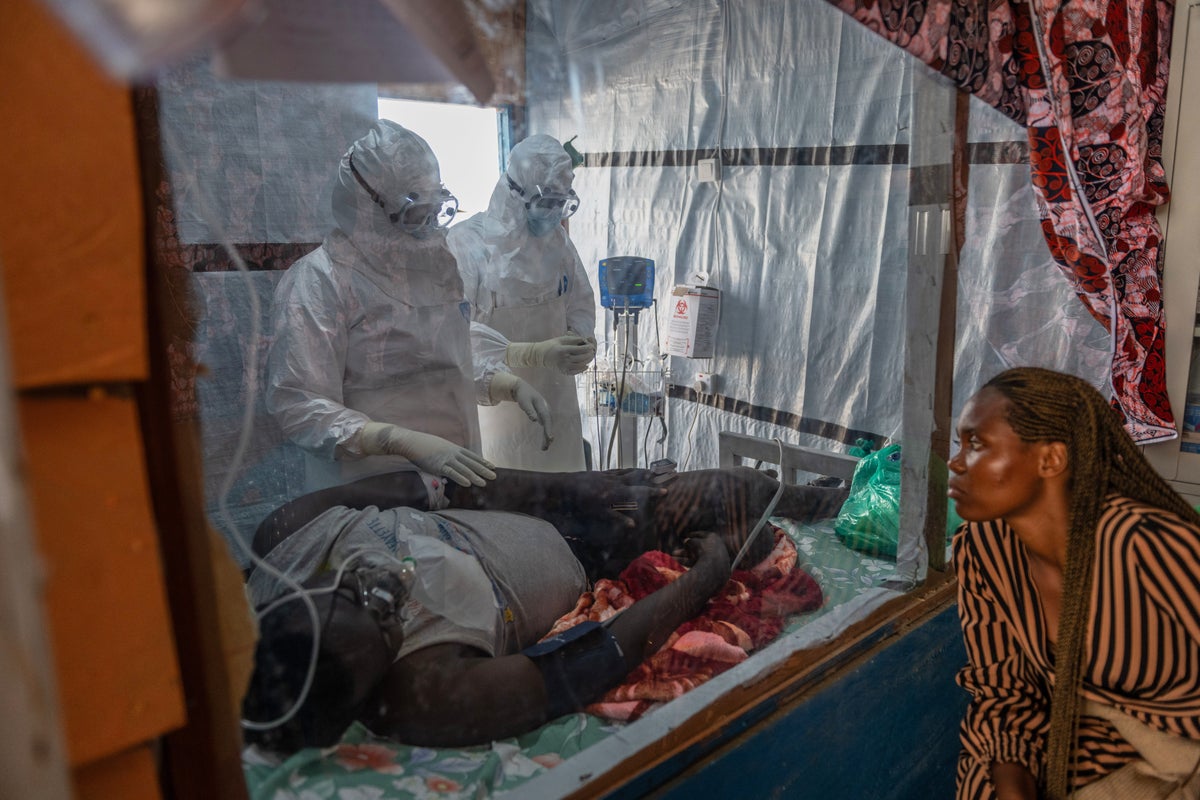
It is hard to imagine a more challenging place for a deadly outbreak to unfold. Every day of reporting began and ended with a careful process of protection and disinfection. Ebola is highly contagious and can be contracted via bodily fluids such as vomit, blood or semen.
That meant putting on gloves, masks and hair nets in 80-degree Fahrenheit heat (26 Celsius) and 80% humidity. Our driver's vehicle, our microphones and other equipment had to be disinfected after entering outbreak-affected areas. As we reported at struggling health centers, the sound of crying families followed us.
The air was thick and humid, and people were slick with sweat. Health workers moved between crowded wards, washing their hands again and again.
The Ebola outbreak is centered in neighboring Ituri province, scarred by years of such conflict. Armed groups control some areas and nearly a million people have been displaced. Economic hardships have now deepened. In the first three weeks after this outbreak was declared in mid-May, at least 520 security incidents, including attacks on health workers, impacted the work of responders, the World Health Organization said.
Attacks continue to be reported. We saw hospital beds left charred, the patients having fled. Other people with confirmed or suspected Ebola infections have been abducted, disappearing into a world of poor mobile phone signal and bone-shaking unpaved roads.
Local people are coordinating the community response. At least four health zones in Ituri, encompassing thousands of people, remain inaccessible because they are under rebel control. Unable to enter, response teams are relying in part on rebel leaders to pass on Ebola prevention messages and encourage participation in measures meant to slow the spread of the virus.
Misinformation and fear are the biggest challenges. Many residents do not trust the Ebola response. Some believe the disease is not real. In a region long traumatized by attacks and exploitation of rich natural resources, people are wary of outsiders.
A lack of understanding of Ebola, whose symptoms like fever can be mistaken for others like malaria, means the strict prevention measures can be jarring. There has been anger especially around burials, with people told not to do what comes naturally: bathe and prepare a loved one for the grave.
The distrust is one reason health officials don't know the outbreak's true size. Authorities still haven't identified the first person who became ill. Some residents avoid health centers. At times, community health workers who survived an Ebola infection find it difficult to persuade people to take the disease seriously.
One is a nurse who contracted Ebola earlier this year. He told me that many people ask why he survived and others didn't. "Some say that health workers have been paid off, which is why so many people are dying. Others claim that medical staff are actually killing people," the nurse said.
Journalists are not spared. At times, people accused us of being part of a conspiracy to invent the disease. Once, an angry crowd gathered outside a health center where we planned to report. Its director told us to come back another day.
People are learning to adjust to the outbreak even as it grows. At bars, face masks, temperature checks and socially distanced dancing are now part of a night out. Weddings have continued, with veils replacing face masks. At churches, attendants in nurse-like white gowns marked with red crosses hand out Communion wafers.
And during a World Cup match between Congo and Portugal, hundreds of fans embraced and cheered on the team at bars and roadside viewing areas, overjoyed at Congo's first World Cup showing in over half a century.
Single source — no framing comparison available.
ABC NewsA Utah court began reviewing evidence Monday to decide whether Tyler James Robinson should stand trial for the September 2025 killing of conservative activist Charlie Kirk. Prosecutors plan to introduce DNA matches, text messages, a note and video footage over up to five days. Ki…
news.sky.comITV agreed to sell its broadcast channels and ITVX streaming service to Sky for £1.6 billion. The deal, announced July 6, excludes ITV Studios and remains subject to regulatory approval.
middleeasteye.netMourners filled the streets of the Iranian capital on Monday during the dayslong funeral for slain former Supreme Leader Ali Khamenei. His body is scheduled to be laid to rest Thursday in Mashhad after stops in Qom, Najaf and Karbala.