Substrate
world

NASA Receives Modified Boeing 777 Flying Laboratory at Langley Research Center

NASA has taken delivery of a modified Boeing 777-200ER airliner, set to become its largest research aircraft. The plane arrived at Langley Research Center after modifications in Waco, Texas, and will replace the retired DC-8. It is expected to begin science missions in 2027.
The War Zone
1 source·Apr 23, 8:55 PM(12 days ago)·3m read
|
NASA Receives Modified Boeing 777 Flying Laboratory at Langley Research CenterThe War Zone
Audio version
Tap play to generate a narrated version.
Developing·Limited corroboration so far. This page will refresh as more sources emerge.

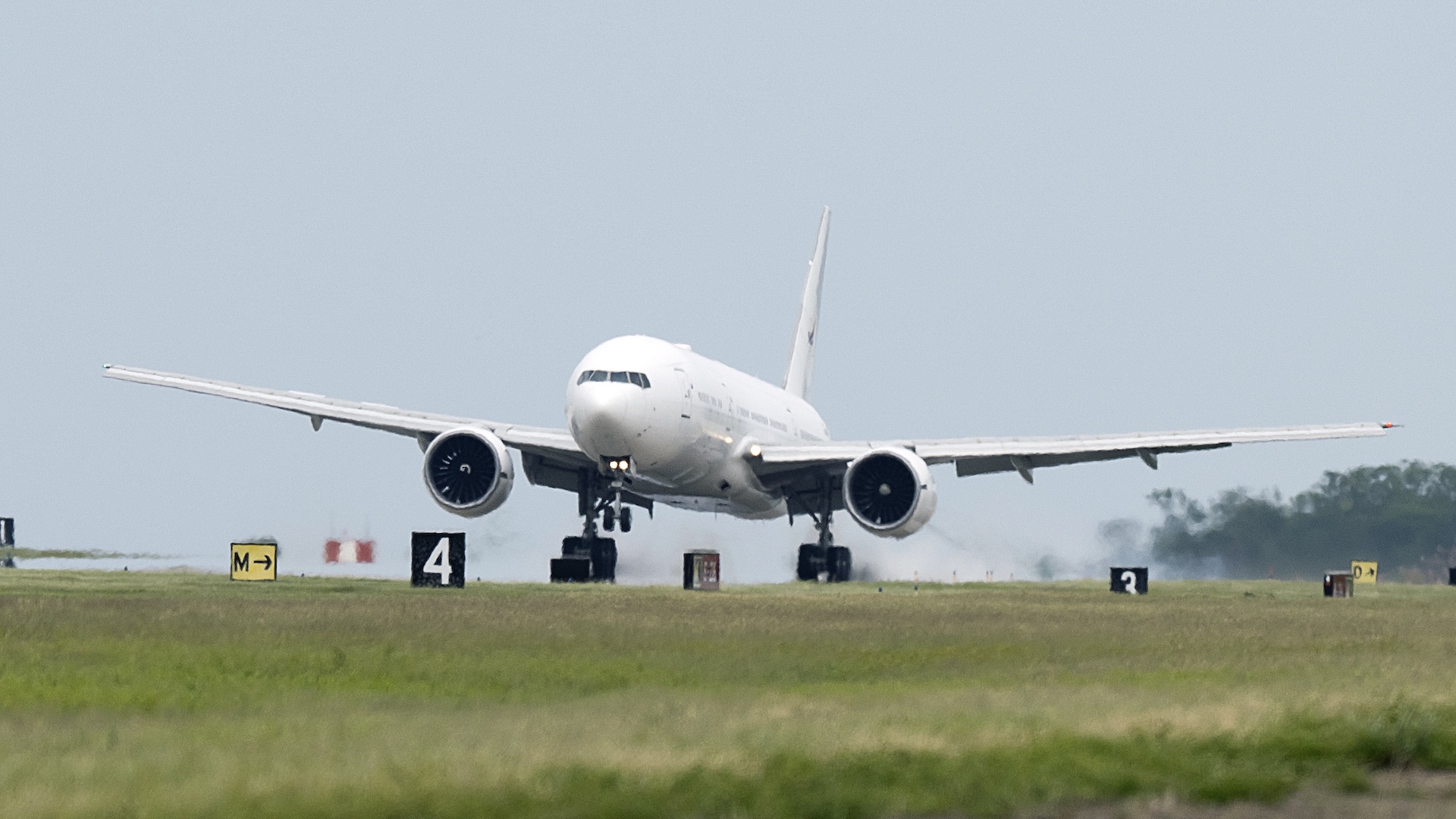
NASA has received its new flying laboratory, a modified Boeing 777 airliner that arrived at the agency's Langley Research Center in Hampton, Virginia, on April 22, 2026. The Boeing 777 completed a check flight and a three-hour transit from Waco, Texas, where it underwent extensive structural modifications. L3Harris, which handled the modifications, delivered the aircraft ahead of schedule.

The Boeing 777, a 777-200ER model manufactured in 2003, was previously flown by Japan Airlines under the registration JA704J. It saw commercial service before going into storage in Southern California in 2020. NASA bought the aircraft in December 2022 for less than $30 million.

The plane underwent an initial series of modifications at NASA Langley Research Center before arriving in Waco in January 2025. L3Harris partnered with Yulista on the modification work, accelerating the program using advanced engineering techniques including 3D scanning and specialized installation tooling. Nearly 35,000 precision holes were drilled into the belly of the aircraft.

Modifications in Waco included the installation of dedicated research stations, extensive wiring, enlarged cabin windows, and ports in the bottom of the fuselage to mount remote-sensing instruments. The Boeing 777 also received new power, data, and communications systems, along with accommodations for instrument operators.

Wiring harnesses in the fuselage allow operators' workstations to communicate with sensors such as LIDAR and infrared imaging spectrometers during flights.

Research station and wiring upgrades in the cabin are being performed by NASA and HII. The Boeing 777 will accommodate between 50 and 100 onboard operators. It offers a useful payload of 75,000 pounds and can conduct missions of up to 18 hours at a maximum altitude of 43,000 feet.

The Boeing 777 will become NASA’s largest research aircraft platform, taking over from the agency’s retired Douglas DC-8. The DC-8, from 1969, accommodated 45 researchers and flight crew, could carry 30,000 pounds of scientific instruments and equipment, and typically conducted missions lasting between six and 10 hours.

NASA retired the DC-8 after it returned to Armstrong Flight Research Center in Palmdale, California, on April 1, 2024, following its final test mission.

The Boeing 777 carries the registration N577NA. It will be used for gathering Earth science data, including using sensors to monitor activities and phenomena on the surface of the globe, such as studying polar ice fields and monitoring wildfires. Earth sciences missions will involve remote sensing and gas sampling instruments.

Airborne missions at NASA use cutting-edge instruments to explore and understand our home planet. The 777 will be the largest airborne research laboratory in our fleet, collecting data to improve life on our home planet and extend our knowledge of the Earth system as a whole.

I’m excited for what the 777 will bring. Being part of that team, I got to see the impact up close. It gives us the ability to bring together more partners, more educational opportunities, and more instruments. That will make a real difference in the data we collect moving forward.

The Boeing 777 will primarily be used for airborne science campaigns but will support a variety of other mission requests as the aircraft is available, similar to the DC-8, a NASA spokesperson said. The DC-8’s mission spectrum included sensor development, satellite sensor verification, telemetry data retrieval, optical tracking for space vehicle launch and re-entry, and research studies of the Earth’s surface and atmosphere.

The Boeing 777 is expected to fly its first science mission in January 2027 as part of the North American Upstream Feature-Resolving and Tropopause Uncertainty Reconnaissance Experiment (NURTURE). The NURTURE mission will involve studying high-impact winter weather events, including severe cold air outbreaks, wind, snow and ice storms, and hazardous seas.

It will gather data in North America, Europe, Greenland, and the Arctic and North Atlantic Oceans.

The NURTURE payload has been installed on the Boeing 777 alongside general modification work. NASA also retired the Stratospheric Observatory for Infrared Astronomy (SOFIA), a Boeing 747SP, in 2022. The War Zone reported these details on the Boeing 777's modifications and capabilities.

Key Facts

NASA receives new Boeing 777 flying laboratory
The modified 777-200ER arrived at Langley on April 22, 2026, after modifications by L3Harris in Waco.
Boeing 777 to replace retired DC-8
The 777 offers greater capacity, with up to 100 operators, 75,000-pound payload, and 18-hour missions at 43,000 feet, compared to DC-8's 45 operators, 30,000 po
First science mission set for 2027
The Boeing 777 will fly in the NURTURE experiment studying winter weather events across North America, Europe, Greenland, and Arctic regions.
Modifications include advanced features
Nearly 35,000 holes drilled, enlarged windows, fuselage ports, new systems, and wiring for sensors like LIDAR.
Aircraft history and cost
Built in 2003, formerly JA704J with Japan Airlines, stored in 2020, purchased by NASA in 2022 for under $30 million.

Story Timeline

6 events
  1. 2026-04-22

    The Boeing 777 arrived at NASA’s Langley Research Center in Hampton, Virginia, after a check flight and three-hour transit from Waco.

    1 sourceThe War Zone
  2. 2025-01

    The Boeing 777 arrived in Waco, Texas, for modifications after initial work at NASA Langley.

    1 sourceThe War Zone
  3. 2024-04-01

    NASA’s DC-8 returned to Armstrong Flight Research Center in Palmdale, California, after its final test mission.

    1 sourceThe War Zone
  4. 2022-12

    NASA bought the Boeing 777 for less than $30 million.

    1 sourceThe War Zone
  5. 2022

    NASA retired the Stratospheric Observatory for Infrared Astronomy (SOFIA), a Boeing 747SP.

    1 sourceThe War Zone
  6. 2020

    The Boeing 777 went into storage in Southern California.

    1 sourceThe War Zone

Potential Impact

  1. 01

    Modernization of NASA's fleet following retirements of DC-8 and SOFIA.

  2. 02

    Enhanced NASA airborne research capabilities with larger payload and longer missions.

  3. 03

    Improved data collection for Earth science, including weather and environmental monitoring.

  4. 04

    Support for diverse missions beyond primary Earth science campaigns.

  5. 05

    Increased partnerships and educational opportunities in scientific research.

Transparency Panel

Sources cross-referenced1
Framing risk0/100 (low)
Confidence score75%
Synthesized bySubstrate AI
Word count660 words
PublishedApr 23, 2026, 8:55 PM
Bias signals removed4 across 4 outlets
Signal Breakdown
Loaded 2sensationalism 1Speculative 1

Related Stories

Trump Pauses US Operation in Strait of Hormuz to Advance Iran Deal TalksTrump White House Archived from Washington, DC / Wikimedia (Public domain)
world1 hr ago

Trump Pauses US Operation in Strait of Hormuz to Advance Iran Deal Talks

President Trump announced a temporary pause to Project Freedom, the U.S. effort to guide ships through the Strait of Hormuz, citing progress toward a settlement with Iran. The blockade on Iranian ports remains in effect, while Secretary of State Marco Rubio stated that the offens…

The Guardian
Al Jazeera
DE
UN
NE
+87
92 sources
Tom Homan Discusses Minneapolis Immigration Enforcement After Shootinginquisitr.com
world1 hr agoDeveloping

Tom Homan Discusses Minneapolis Immigration Enforcement After Shooting

Tom Homan, White House Border Czar, stated that mass deportations can proceed in a smarter way. He acknowledged imperfections in the Minneapolis immigration crackdown following a deadly shooting. Homan highlighted efforts to address and fix issues after President Trump sent him t…

DI
Cbs News
2 sources
Canadian House Committee Hears Testimony on EV Import Deal with ChinaOffice of David Schweikert, US Congress / Wikimedia (Public domain)
world1 hr agoFraming55Framing risk55/100Rewrite foregrounds risks and criticisms in lede, burying benefits and deal details, creating a negative valence skew on the EV import policy.Click to jump to full framing analysis

Canadian House Committee Hears Testimony on EV Import Deal with China

Industry experts and policy leaders testified before a Canadian parliamentary committee on the economic and security risks posed by a new trade agreement permitting low-tariff imports of Chinese electric vehicles. The deal, signed in January 2026, reduces tariffs and sets import…

ZE
ABC News
zerohedge.com
3 sources