Substrate
ai

Sensors and AI Help Water Companies Detect Sewer Fatbergs

Fatbergs, hardened masses of fat, oil, grease and discarded items, regularly block sewers in cities worldwide and require manual removal. UK water companies have installed thousands of sensors linked to machine learning systems that flag abnormal water levels for early intervention.

bbc.com
1 source·May 12, 10:00 AM(17 days ago)·2m read
Sensors and AI Help Water Companies Detect Sewer Fatbergsbbc.com
Audio version
Tap play to generate a narrated version.
Developing·Limited corroboration so far. This page will refresh as more sources emerge.

Fatbergs, accumulations of fat, oil, grease, wet wipes, sanitary products and other debris that harden in sewer systems, continue to form in cities around the world. These blockages can cause sewage backups into homes and streets as well as pollution in rivers when sewers overflow.

Water companies are deploying sensors and artificial intelligence to identify developing fatbergs before they reach large sizes. The mass required nine weeks of manual removal using pickaxes and high-pressure water jets. By the end of 2025, a similar fatberg had regrown in the same Victorian-era sewer to more than 100 tonnes.

Richard Martin, head of treatment improvement at Southern Water, described the material as "a magical mixture" that hardens like concrete. Southern Water, which manages sewers in southeast England, tackles an estimated 300,000 accumulations of fat, oil and grease each year across its network.

Southern Water has installed around 34,000 sensors attached to manhole covers. The sensors use radar to measure water levels in the sewers below and transmit the data to a machine learning system. That system combines the readings with rainfall and weather information to establish expected water levels for any given day.

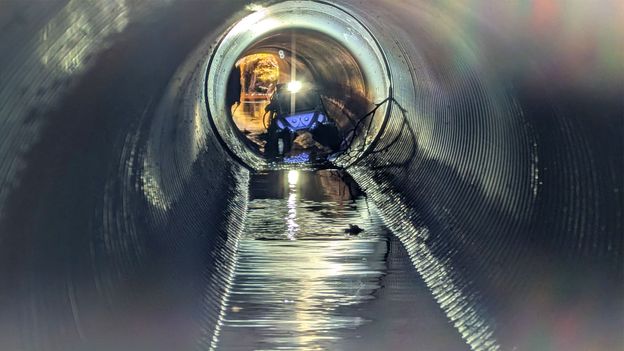
"If it pops outside of that band, that's when we react," Martin said. The approach allows crews to address blockages before they solidify and grow. Historically, companies relied on customer reports or scheduled inspections. The technology has also reduced the need for workers to enter sewers, where they face exposure to hydrogen sulphide, methane, carbon dioxide, viruses, bacteria and parasites.

Southern Water cleared 700 blockages using the AI system so far in 2025. In the prior full year the company handled between 3,500 and 4,000 blockages in total.
City spends about $18.8 million annually to remove grease-related blockages, which account for 40 percent of its sewer backups. Large fatbergs have also been recorded in Detroit, Baltimore, Liverpool, Oxford, Melbourne and Sydney. A 300-tonne fatberg found in Birmingham in 2021 extended 1 kilometre while standing less than 1 metre high.

In Sydney, a recent fatberg ejected material described as "poo balls" that reached beaches in New South Wales. Chunks of the 2017 Whitechapel fatberg are now on display at the Museum of London. Scientists have collected samples to study the chemical processes involved.

Raffaella Villa, head of the school of engineering at Lancaster University, analysed material from the Whitechapel fatberg. She described the dried substance as hard and waxy, similar in texture to soap. Villa has suggested that milk and high-pH dishwasher water from coffee shops could contribute to fatberg formation by creating conditions similar to cheese-making.

She has applied for funding to use machine learning on sewer samples to help identify the hardest, most established fatbergs for priority removal. Cities in the UK and US already deploy camera-equipped robots to inspect sewers for early signs of buildup, though many are still manually operated.

com.

Key Facts

130-tonne fatberg
found under London Whitechapel Road in 2017
34,000 sensors
installed by Southern Water on manhole covers
700 blockages
cleared by Southern Water with AI in 2025
47% drop
in sewage spills for Southern Water in 2025
$18.8 million
spent yearly by New York City on grease blockages

Story Timeline

4 events
  1. End of 2025

    A fatberg over 100 tonnes was found regrown under London's Whitechapel Road.

    1 sourcebbc.com
  2. 2025

    Southern Water cleared 700 blockages using AI sensors and reported 15,500 sewage spills, a 47% drop from 2024.

    1 sourcebbc.com
  3. 2021

    A 300-tonne fatberg was excavated in Birmingham, UK.

    1 sourcebbc.com
  4. 2017

    A 130-tonne fatberg was discovered and removed from under London's Whitechapel Road after nine weeks of work.

    1 sourcebbc.com

Potential Impact

  1. 01

    Fewer sewage spills reached rivers and streets in Southern Water's area in 2025.

  2. 02

    Water company workers spent less time inside hazardous sewer environments.

  3. 03

    Earlier detection may reduce property flooding from sewer backups.

  4. 04

    Museums continue to display fatberg samples for public education.

Transparency Panel

Sources cross-referenced1
Confidence score65%
Synthesized bySubstrate AI
Word count495 words
PublishedMay 12, 2026, 10:00 AM
Bias signals removed2 across 2 outlets
Signal Breakdown
Loaded 2

Related Stories

Anthropic Raises $65 Billion at $965 Billion ValuationSemafor
ai1 hr agoDeveloping

Anthropic Raises $65 Billion at $965 Billion Valuation

Anthropic completed a $65 billion funding round at a $965 billion valuation. The round follows earlier growth that exceeded internal forecasts and a separate agreement to lease computing capacity.

Semafor
1 source
South African Researchers Develop Quantum and AI Tools for Cybersecuritythesouthafrican.com
ai1 hr agoDeveloping

South African Researchers Develop Quantum and AI Tools for Cybersecurity

Scientists and startup companies in South Africa are applying quantum communication and AI-powered tools to address rising global cyber threats. The work focuses on strengthening data protection methods.

Reuters
1 source
EU Discusses Readiness for Artificial Intelligence ChangesFrance 24
ai5 hrs agoDeveloping

EU Discusses Readiness for Artificial Intelligence Changes

A France 24 program examined whether European Union policies can address the effects of artificial intelligence. The discussion covered potential impacts across daily life and economic sectors.

France 24
1 source