U.S. Special Operations Command Reports Increasing Use of AI to Enhance Targeting and Decision Speed
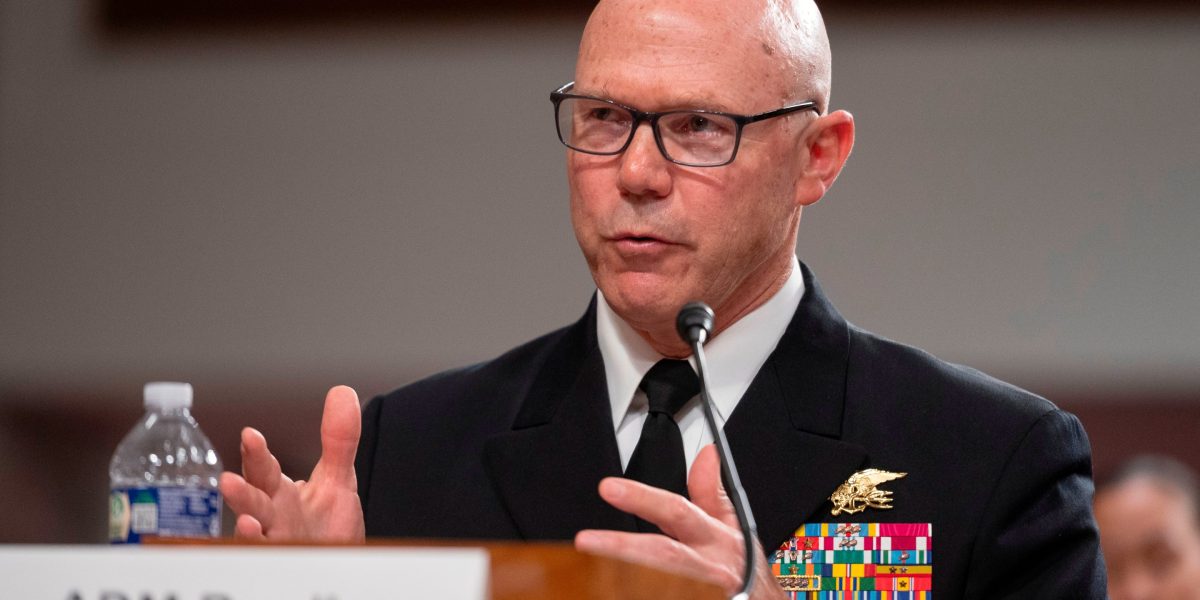
Admiral Frank Bradley said humans must retain confidence that AI will deliver violence only where intended. Defense Secretary Pete Hegseth continues to push rapid AI adoption across the military.
 fortune.com
S. ” Defense Secretary Pete Hegseth is pushing to rapidly evolve the military through AI. ” President Trump abruptly called off plans to sign a new AI executive order hours before an expected White House ceremony.
A Pentagon official said efforts are focused on using AI to create “functional battlefield tools” that can help troops come up with and identify targets more quickly and speed up strikes on those targets. The official spoke on condition of anonymity. S.
Special Operations Command, said at the conference that he sees AI handling administrative tasks to free up operators or helping modernize how the command does business. ” “We’re leveraging AI more and more, but it’s not to replace operator judgment, it’s to enhance it,” she added. S.
Military is actively exploring. General Michael Conley, head of Air Force Special Operations Command, told a congressional committee in May that his troops used AI “bots” to convert top secret intelligence down to a secret classification within seconds to make it easier to share with drone operators on the ground during the Iran war.
Georgetown University’s Center for Security and Emerging Technology published a case study two years ago on how the Army’s 18th Airborne Corps used AI to target artillery strikes “just as efficiently as the best unit in recent American history” and with 2,000 fewer service members.
“Human operators are still the ones making crucial decisions, but AI … is making it possible to operate with a new level of speed and scale,” Toner said. The Pentagon ended its $200 million contract with Anthropic after labeling the company a supply-chain risk and barred other contractors from working with it.
Anthropic sued, alleging illegal retaliation after CEO Dario Amodei refused to drop concerns over autonomous armed drones and AI-assisted mass surveillance.
The Pentagon has since emphasized its turn to Google, OpenAI and SpaceX to secure AI technology that can augment warfighter decision-making in complex operational environments. S. ” “Commanders want their missions to succeed, which means both being able to create lethal effects at scale, and avoiding unintended effects like friendly fire, civilian casualties, or simply identifying targets incorrectly,” she said.
Transparency
5 core facts confirmed by 2+ independent outlets, spanning multiple sides of the spectrum. 19 single-source, 0 disputed.
Confirmed across the spectrum, but among lower-tier outlets — diverse yet not from established sources.
2 outlets classified · 1 left · 1 center · 0 right. Coverage spans the spectrum.
- The Boston Globe reported: President Trump abruptly called off plans to sign a new AI executive order hours before an expected White House ceremony over concerns the measure could dull America’s edge on AI technology.
- The Boston Globe reported: The Pentagon labeled Anthropic a supply chain risk, ending its $200 million defense contract and prohibited other government contractors from working with the company.
- The Boston Globe reported: President Trump said 'We’re leading China, we’re leading everybody, and I don’t want to do anything that’s going to get in the way of that lead.'
- The Boston Globe reported: Pete Hegseth and Anthropic are in a contract dispute over the company’s concerns about unchecked government use of its technology including fully autonomous armed drones and AI-assisted mass surveillance.
- The Boston Globe reported: Pete Hegseth told an audience of SpaceX employees in January that he would reject any AI models that won’t allow you to fight wars and that his vision was systems that operate without ideological constraints that limit lawful military applications.
- The Boston Globe reported: A Pentagon official said efforts are focused on using AI to create functional battlefield tools that can help troops come up with and identify targets more quickly and speed up strikes.
- The Boston Globe reported: General Michael Conley told a congressional committee in May that his troops used AI bots to convert top secret intelligence down to a secret classification within seconds to make it easier to share with drone operators on the ground during the Iran war.
- The Boston Globe reported: After Anthropic CEO Dario Amodei refused to back down over concerns about how the chatbot Claude is used in classified Pentagon networks, both Trump and Hegseth accused Anthropic of endangering national security.
- The Boston Globe reported: Anthropic sued the Pentagon claiming it is illegally retaliating by stigmatizing the company with a designation meant to protect against sabotage by foreign adversaries.
- The Boston Globe reported: Helen Toner said there are a huge number of potential uses for AI in bureaucratic settings which the U.S. military is actively exploring and that human operators are still the ones making crucial decisions but AI is making it possible to operate with a new level of speed and scale.
- The Boston Globe reported: Georgetown University’s Center for Security and Emerging Technology published a case study two years ago on how the Army’s 18th Airborne Corps used AI to target artillery strikes just as efficiently as the best unit in recent American history and with 2,000 fewer service members.
- The Boston Globe reported: Melissa Johnson said AI should be reducing the cognitive workload on mundane tasks and that the command is leveraging AI more and more but it is not to replace operator judgment, it is to enhance it.
- The Boston Globe reported: The Pentagon has emphasized its turn to Google, OpenAI and SpaceX to secure AI technology that can augment warfighter decision-making in complex operational environments.
- The Boston Globe reported: Sergeant Major Andrew Krogman said he sees AI handling administrative tasks to free up operators or helping modernize how the command does business.
- The Boston Globe reported: Helen Toner said the general public often seems to underestimate the caution with which the U.S. military approaches new technologies and that commanders want their missions to succeed which means both being able to create lethal effects at scale and avoiding unintended effects like friendly fire, civilian casualties or simply identifying targets incorrectly.
- The Boston Globe reported: General Michael Conley is head of Air Force Special Operations Command.
- The Boston Globe reported: Sergeant Major Andrew Krogman is the top enlisted official for U.S. Special Operations Command.
- The Boston Globe reported: Melissa Johnson is the top acquisition official for U.S. Special Operations Command.
- The Boston Globe reported: Helen Toner is interim executive director at Georgetown University’s Center for Security and Emerging Technology.
Story details
Related Stories
 Semafor
Anthropic Raises $65 Billion at $965 Billion Valuation
Anthropic completed a $65 billion funding round at a $965 billion valuation. The round follows earlier growth that exceeded internal forecasts and a separate agreement to lease computing capacity.
 rove.me
South African Researchers Develop Quantum and AI Tools for Cybersecurity
Scientists and startup companies in South Africa are applying quantum communication and AI-powered tools to address rising global cyber threats. The work focuses on strengthening data protection methods.