Well Done Foundation Plugs 29 Orphaned Wells at Oklahoma’s Deep Fork National Wildlife Refuge
The nonprofit has plugged 29 wells in the Deep Fork National Wildlife Refuge under a $19.3 million U.S. Fish and Wildlife Service grant awarded in December 2024. Work continues even after the Department of the Interior paused some plugging funds to states in April following President Trump's inauguration executive order.
 Inside Climate News
U.S. Fish and Wildlife Service on Dec. 20, 2024.
The grant, funded by the Infrastructure Investment and Jobs Act, aims to plug and reclaim 111 orphaned well sites on at least 5 national wildlife refuges. The organization has since plugged 29 wells in its first 11 months in the refuge, which was established in 1993 and is home to 149 species of birds, as many as 59 of fish, 54 of reptiles, 22 of amphibians and countless types of insects including the endangered American burying beetle.
The work occurs amid shifting federal policy.
On the day he was inaugurated for his second term, President Donald Trump signed his “Unleashing American Energy” executive order. U.S. Department of the Interior paused dispersal of plugging and capping funds to oil-producing states.
The department remains committed to carrying out the Orphaned Wells Program as Congress directed, a spokesperson said, while actively evaluating the Bureau of Land Management’s bonding rule under Executive Order 14154. The Bureau of Land Management finalized an update to onshore oil and gas leasing in 2024 to bring public lands bonding requirements in line with contemporary well remediation costs.
The new BLM bonding rules were due to go into effect in June 2025 but in December the agency extended the deadline for compliance while the DOI proposed the rule’s recission.
At the time of the regulatory update’s proposal the BLM was reporting 37 orphan wells on BLM lands. The 2023 Orphaned Wells Program report cites 599 federal orphans in its database.
U.S. Out of about 4 to 5 million that have been drilled since 1859. The EPA says 58 percent of abandoned wells it has logged are not plugged. The federal Orphaned Wells Program documented 141,000 orphaned wells nationally and estimates an additional 250,000 to 740,000 out there.
6 million people, live within about a half-mile of an AOOG well. S. energy sector.
In December the New Mexico attorney general sued three Texas oilmen accusing them of selling more than 500 unproductive wells to shell companies created to declare bankruptcy and avoid remediation costs. More than 8,000 wells have been inactive for more than a year under delinquent ownership in Texas.
Between 2021 and 2024 the Texas Railroad Commission added 2,139 wells to its roster of abandoned and orphaned wells.
Texas Governor Greg Abbott signed legislation in June 2025 that set aside $100 million to plug orphaned wells. The Oklahoma Corporation Commission said it would cost just over $500 million to plug, reclaim or decommission 17,865 abandoned and orphaned wells on state or private land, budgeting about $28,100 per well.
Twenty-six of 32 states had applied for IIJA Orphaned Wells Program funding including Texas, Alaska, New Mexico, North Dakota and Colorado.
The 26 states listed 126,806 AOOG wells on state or private land that would cost more than $9 billion to plug, an average of nearly $72,500 per well. 9 million that year. 6 million cost.
Inside Climate News reported that the pause in funding has raised concerns among state and federal agencies, though IIJA state grant plugging money is moving again. Curtis Shuck is chairman of the Well Done Foundation, whose office is in Okmulgee, Okla.
He previously managed facilities at the Port of Los Angeles and was the senior sales director of the Port of Vancouver USA before transitioning to well plugging.
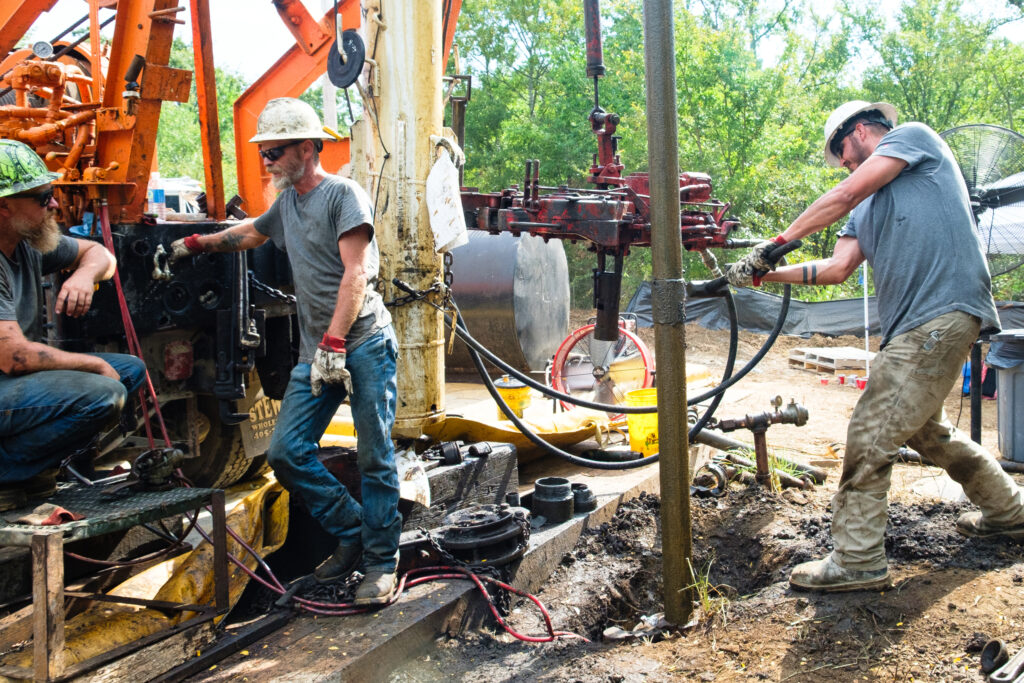
In August heat indexes regularly exceeded 110 degrees Fahrenheit at the Doneghy #2 well site in the Deep Fork National Wildlife Refuge near Okmulgee, Oklahoma. Isabella Osario, Curtis Shuck and Micaela Short conferred on Aug.
The Doneghy #2 well vents pressure and releases crude, saline water, methane and small amounts of hydrogen sulfide gas. The USFWS is proposing to list the tricolored bat as endangered and protects the bats by limiting well-plugging habitat disruptions. ” Shuck also said “I may have thought I was out there to change the world, the reality is that it was actually changing me.
He said of TRC’s increased AOOG count “A goodly number of wells were added in a chunk” in part due to the OWP funds. S.
Key Facts
Story Timeline
7 events- 2026-05-10
Current date; article reflects ongoing work at Deep Fork National Wildlife Refuge and policy pauses from earlier in 2025
1 sourceInside Climate News - Aug. 6, 2025
Isabella Osario, Curtis Shuck and Micaela Short conferred at the Doneghy #2 well site amid heat indexes regularly exceeding 110 degrees Fahrenheit
1 sourceInside Climate News - June 2025
Texas Governor Greg Abbott signed legislation setting aside $100 million to plug orphaned wells; BLM bonding rules originally due to take effect
1 sourceInside Climate News - April 2025
U.S. Department of the Interior paused dispersal of plugging and capping funds to oil-producing states
1 sourceInside Climate News - January 2025
President Donald Trump signed “Unleashing American Energy” executive order on inauguration day for his second term
1 sourceInside Climate News - Dec. 20, 2024
U.S. Fish and Wildlife Service awarded Well Done Foundation $19.3 million grant to plug 111 orphaned well sites
1 sourceInside Climate News - December 2024
New Mexico attorney general sued three Texas oilmen; BLM extended deadline for bonding rules
1 sourceInside Climate News
Potential Impact
- 01
State-level funding such as Texas' $100 million allocation and Oklahoma's estimated $500 million need addresses localized orphaned well burdens
- 02
Nonprofit and contractor efforts like Well Done's demonstrate private-sector role in remediation where federal and state programs face political volatility
- 03
Continued well plugging in federal refuges despite state funding pause supports wildlife habitat protection and limits methane emissions
- 04
Regulatory revisions to bonding requirements remain under DOI review, potentially affecting future orphan well proliferation on public lands
Transparency Panel
Related Stories
 Usa Today
MV Hondius Docks in Canary Islands After Hantavirus Cases Confirmed on Board
The cruise ship that departed Argentina in an Andes virus outbreak will dock in Tenerife on Sunday for screening and repatriation of more than 140 passengers and crew. WHO has confirmed six Andes virus cases among eight total infections linked to the vessel, with three deaths. He…
 The Japan Times
Japanese Local Governments Recover Small Amounts of Phosphorus from Sewage Sludge for Fertilizer
Eight prefectural and municipal governments operated 11 phosphorus recovery facilities by the end of fiscal 2025 as Japan seeks to cut reliance on imported fertilizer. Tokyo and Fukuoka have launched new systems, with the capital planning nationwide distribution from fiscal 2026.…
 indianexpress.com
Argentina Amends 2010 Glacier Law to Permit Mining in Periglacial Areas After Technical Review
Argentine legislators last month passed changes to the Glacier Law that had banned all mining and exploration in glacier regions since 2010. The country’s 16,000 glaciers, covering 8,484 sq km, were previously defined as public goods. Separately, Alannah Hurley received the 2026…