Supreme Court Considers Preemption in Glyphosate Labeling Case
The U.S. Supreme Court heard arguments in Monsanto v. Durnell, weighing whether federal law under FIFRA blocks state lawsuits claiming Bayer failed to warn about cancer risks from its Roundup weedkiller. Justices appeared divided on whether EPA approval preempts state labeling requirements. The case could affect thousands of similar lawsuits against the company.
Diliff / Wikimedia (CC BY-SA 3.0)The U.S. Supreme Court heard oral arguments on April 27, 2026, in Monsanto v. Durnell, examining whether the Federal Insecticide, Fungicide, and Rodenticide Act (FIFRA) preempts state failure-to-warn claims against Bayer for its Roundup weedkiller. The case stems from plaintiff John Durnell's allegation that his non-Hodgkin lymphoma resulted from glyphosate exposure, leading to a $1.25 million Missouri jury verdict in 2019, upheld on appeal.
According to EPA data cited in court filings, glyphosate is applied to approximately 300 million acres of U.S. farmland each year, with about 280 million pounds used annually. The EPA has approved Roundup labels without cancer warnings, stating in its 2020 interim decision that "glyphosate is not likely to be carcinogenic to humans" based on its review of scientific studies.
The International Agency for Research on Cancer classified glyphosate as "probably carcinogenic to humans" in 2015, though the EPA has not adopted this classification.
Paul Clement, attorney for Monsanto, argued during the hearing that FIFRA's provision prohibits states from imposing "any requirements for labeling or packaging in addition to or different from" federal standards, as stated in the statute. He cited the 2008 Supreme Court decision in Riegel v.
" Ashley Keller, representing Durnell, argued that FIFRA registration does not equate to a binding safety determination, noting a 2022 Ninth Circuit ruling that vacated portions of the EPA's glyphosate assessment for inadequate ecological analysis, though the court did not address human health findings.
Justices questioned both sides on uniformity and scientific updates. Justice Brett Kavanaugh asked about the risks of "retroactive penalties" from varying state rules. Justice Ketanji Brown Jackson inquired how new evidence might be addressed given EPA reviews occur every 15 years. No clear majority emerged from the arguments, according to observations reported in multiple outlets.

Bayer has faced over 100,000 lawsuits related to Roundup and has paid billions in settlements while asserting that "the extensive body of science over 40 years confirms that glyphosate does not cause cancer," as stated in company filings. The Trump administration issued an executive order in 2026 designating glyphosate production protection as a national security issue, citing its role in food security.
A ruling for Bayer could limit similar claims, with a decision expected by June 2026.
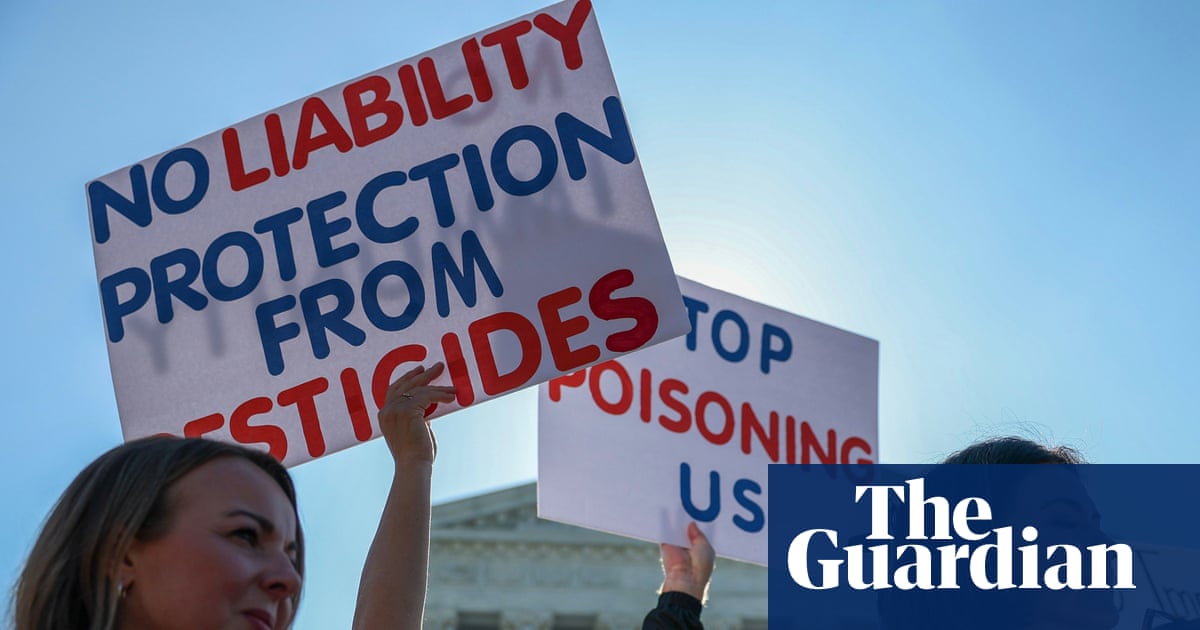
Protesters gathered outside the court with signs reading "people over poison," affiliated with groups like Moms Across America. Zen Honeycutt, founder of Moms Across America, said companies must be held accountable. Alexandra Munoz, an independent toxicologist, described glyphosate as a carcinogen based on scientific literature.
Daniel Hinkle, senior counsel for the American Association for Justice, noted that both sides presented compelling arguments. A Politico poll in early April 2026 found about 70% of respondents favored greater pesticide restrictions. The vessels' operators have not been publicly identified by the U.S. government in relation to any specific enforcement actions mentioned in the sources.
No publicly released evidence has documented direct links between the executive order and the court's deliberations.
Key Facts
Story Timeline
5 events- Apr 27, 2026
Supreme Court heard oral arguments in Monsanto v. Durnell on FIFRA preemption for Roundup labels.
7 sourcesWSJ · NYT · Guardian - Early April 2026
Politico poll showed nearly 70% support for greater pesticide restrictions.
1 sourceWashington Examiner - 2022
Ninth Circuit vacated EPA findings on glyphosate health risks.
1 sourceGuardian - 2019
Missouri jury awarded John Durnell $1.25 million in lawsuit against Monsanto.
2 sourcesWashington Examiner · Guardian - 2015
International Agency for Research on Cancer classified glyphosate as probably carcinogenic.
4 sourcesWashington Examiner · Guardian · NPR
Potential Impact
- 01
Bayer could end ongoing litigation if court rules in its favor.
- 02
Thousands of cancer lawsuits against pesticide makers may be blocked.
- 03
Farm Bill amendment would remove manufacturer protections from lawsuits.
- 04
Make America Healthy Again movement gains momentum in 2026 midterms.
- 05
EPA may face pressure to update glyphosate reviews more frequently.
- 06
Protests could influence public support for pesticide regulations.
Transparency Panel
Related Stories
channelnewsasia.comU.S. Pauses One-Day Ship Guidance in Strait of Hormuz as Iran Talks Advance
President Trump announced a pause in the one-day-old effort to guide ships out of the Strait of Hormuz, citing progress toward an agreement with Iran. Secretary of State Marco Rubio declared the war with Iran concluded after a month-old cease-fire. The U.S. blockade remains in pl…
Spirit Airlines Cancels All Flights and Begins Wind-Down After Failed $500M Bailout Talks
Spirit Airlines announced the immediate wind-down of its operations on Saturday, canceling all flights and stranding passengers and workers. The decision followed the collapse of discussions with the Trump administration for a $500 million bailout. Other U.S. airlines offered res…
Democrats in Congress Urge Trump Administration to Acknowledge Israel's Nuclear Program
A group of Democrats in Congress sent a letter to the U.S. Secretary of State urging public acknowledgment of Israel's nuclear weapons program. The lawmakers cited risks of escalation amid the war in Iran and argued that U.S. silence on the issue affects credibility on global nuc…